
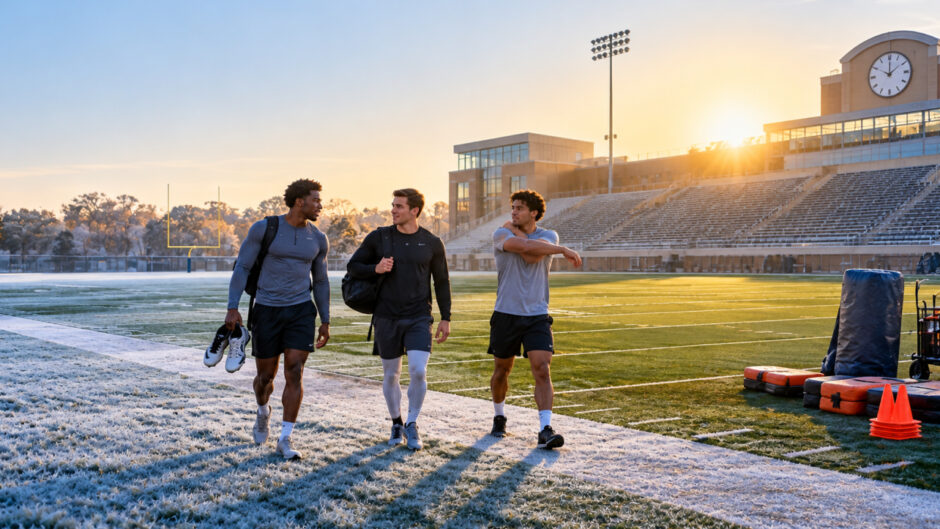
College football’s calendar may look different in 2027, with a proposed NCAA model reorganizing how Football Bowl Subdivision athletes practice, train and receive protected discretionary time outside the regular season.
At the center of Division I Proposal 2026-57 are nine designated weeks of student-athlete discretionary time, two out-of-season practice periods totaling no more than seven weeks, a maximum of 21 out-of-season on-field practices and a shorter preseason. The NCAA Football Bowl Subdivision Oversight Committee adopted the proposal on August 27, 2026, then amended it on September 24 so out-of-season on-field practice and noncontact skill instruction would begin February 1 rather than January 1.
As of October 7, 2026, however, the NCAA legislative database still lists the proposal as In Progress and pending Division I Cabinet review. Its proposed effective date is January 1, 2027.
For athletes, coaches and families, the important question is not simply whether nine weeks sounds like more rest. It is whether the structure of the calendar can create better opportunities for physical recovery, sleep, academics, relationships and mental well-being without simply shifting training demands into different parts of the year.
There is also an important misconception to avoid: the proposal does not give FBS players nine entirely new weeks off. Current football rules already contain substantial discretionary-time requirements. The proposal changes how the out-of-season calendar is organized while simultaneously creating additional flexibility for on-field practice.
That makes the athlete-wellness implications more complicated—and more interesting—than the headline number alone suggests.
What Nine Discretionary Weeks Actually Means
Under NCAA Bylaw 17.02.17, student-athlete discretionary time is a period when participation in athletics activities can occur only at the athlete’s discretion. There can be no required workouts, and institutions cannot recommend that athletes participate in weight training or conditioning during that time. Athletes may choose to work out voluntarily, with limited staff involvement permitted for health and safety purposes.
Proposal 2026-57 would require an FBS institution to designate nine seven-day discretionary weeks between January 1 and the start of preseason practice. At least one must occur between the end of the spring academic term and preseason. Schools could count institutional vacation periods such as spring break or summer vacation toward the nine weeks.
That last detail matters.
Nine protected weeks do not necessarily mean nine weeks when athletes have no academic obligations, rehabilitation appointments, jobs, travel, family responsibilities or voluntary personal training. The rule concerns required athletics activity.
It therefore creates an opportunity for recovery rather than guaranteeing a particular recovery outcome.

These Are Not Nine Brand-New Weeks Off
The proposed change can easily be misunderstood as the NCAA suddenly adding nine weeks of rest to the football calendar.
Current FBS rules already require eight designated discretionary weeks between January 1 and preseason. They also require one additional discretionary week during the nine-week summer conditioning period. Other days outside that summer conditioning period can also qualify as discretionary time under existing legislation.
The NCAA’s legislative record reinforces this point. Proposal 2026-57 lists its estimated impact on student-athlete academic or athletics time as “None.”
The significant change is therefore the broader restructuring around those weeks.
Instead of the existing spring-practice and summer-activity framework, FBS programs could hold 21 out-of-season on-field practices beginning February 1. Those practices would have to be divided between two periods totaling no more than seven weeks, and neither period could exceed five consecutive weeks. At least one discretionary week would have to separate the final out-of-season on-field practice from preseason.
That structure gives programs greater control over when football development occurs while drawing clearer boundaries around periods when required activity cannot occur.
The Proposed Calendar Would Also Shorten Preseason
The other major recovery-related change occurs immediately before the season.
Beginning with the 2027 season, the proposal would allow 21 preseason on-field practices across 27 calendar days. The current framework permits up to 25 practices across a longer preseason period.
The FBS Oversight Committee explained that because the new model would create additional opportunities for on-field work during the spring and summer, reducing preseason from 25 to 21 practices was appropriate. The NCAA’s legislative rationale specifically says the shorter preseason is intended to promote student-athlete health, safety and well-being.
The proposed preseason rules would retain additional safeguards. Athletes could not participate in more than three hours of on-field practice in one day, multiple on-field practices could not occur on the same day, and at least three continuous hours of recovery time would be required between an on-field practice and a walk-through. The proposal also limits full-pad and full-contact work.
Those provisions matter because recovery is not determined only by the number of practices on a calendar. Practice intensity, contact exposure, duration, timing, sleep opportunity, nutrition and the accumulation of demands across days all contribute to how an athlete experiences a training period.
Football Players Are Still Reporting Less Sleep Than Other NCAA Athletes
One reason calendar structure deserves attention is sleep.
The NCAA’s 2025 GOALS study found that student-athletes overall were reporting more weekday sleep than in previous editions of the survey. Average weekday sleep had increased by approximately 33 minutes from 2019.
Football, however, remained at the bottom among the sports highlighted by the NCAA.
Football student-athletes reported an average of six hours and 24 minutes of weekday sleep, an improvement from five hours and 51 minutes in 2019 but still the lowest average reported among NCAA sports in the study.
That does not mean football participation itself causes insufficient sleep. College athletes balance training with classes, studying, travel, social relationships, employment and other responsibilities, and sleep needs vary among individuals.
It does show why simply counting practice sessions provides an incomplete picture of recovery.
The NCAA Sport Science Institute treats sleep as part of student-athlete health and performance, noting its connections with recovery, mental health and athletic performance. Its resources emphasize that training demands shift throughout the year and that recovery needs must be considered alongside those changing demands.
Protected time can help create space for sleep. Whether athletes actually obtain more or better sleep depends on what fills that space.
Recovery Is More Than Having No Practice
An athlete can have a day without formal practice and still feel physically or mentally overloaded.
Academic deadlines do not disappear during discretionary weeks. Injured players may still have medical or rehabilitation needs. Athletes may work, travel home, manage NIL commitments or continue training voluntarily. Some may benefit psychologically from remaining physically active even when structured team activities are prohibited.
That is why “time off” and “recovery” should not be treated as synonyms.
Recent sports-science research supports looking at recovery as a combination of workload and individual response rather than a simple practice-versus-rest calculation.
A 2026 prospective study involving 26 collegiate female soccer athletes, for example, found relationships between previous-day training load and measures of nightly recovery, next-day subjective readiness and subsequent performance. The researchers emphasized the value of considering athletes’ subjective readiness alongside traditional performance metrics. The study was conducted in soccer, not football, so its results should not be directly generalized to FBS players.
That limitation itself illustrates an important principle: effective recovery planning should respond to the athlete, the sport and the specific training environment rather than assuming one calendar produces identical outcomes for everyone.

More Flexibility Could Help Or Simply Move The Workload
Proposal 2026-57 is unusual because it combines more out-of-season practice flexibility with fewer preseason practices.
Programs would gain the ability to distribute 21 on-field sessions across two practice periods beginning February 1. During those periods, a maximum of 12 contact practices could occur in each period, with additional restrictions on tackling, consecutive full-contact days and scrimmages. Outside designated practice and discretionary periods, conditioning, weight training, film review and walk-throughs could still occur within applicable limits.
That creates two possible interpretations from a recovery perspective.
Programs could use the flexibility to distribute football activity more deliberately, reduce compressed preseason demands and place genuine recovery blocks at useful points in the year.
Or programs could fill more of the calendar with structured football activity and leave athletes feeling that the sport remains present throughout most of the year, even if the formal rules include protected weeks.
The legislation alone cannot determine which culture develops.
That depends partly on how coaches, performance staff, athletic trainers and administrators implement it.
The Timing Of Discretionary Weeks May Matter As Much As The Number
Nine weeks distributed poorly may not have the same practical value as nine weeks positioned around periods of high cumulative demand.
Consider the different pressures athletes face across a year.
After a season, some players may need physical rehabilitation. During spring semesters, academic demands may intensify. Summer can include coursework, training and family responsibilities. Preseason brings another substantial increase in football-specific preparation.
Proposal 2026-57 would require at least one discretionary week between the final out-of-season on-field practice and preseason, creating a defined transition before camp.
That could be useful, but the NCAA proposal does not claim that one particular distribution of the other eight weeks produces superior physical or mental-health outcomes.
Programs therefore should not treat compliance with the minimum rule as proof that recovery needs have been fully addressed.
Athlete feedback can matter here. Persistent fatigue, deteriorating sleep, unusual soreness, reduced motivation or changes in mood and functioning can have many causes and should not be self-diagnosed from a training schedule. Athletic trainers, physicians, sports dietitians, licensed mental-health professionals and other qualified members of the sports-performance team may need to evaluate concerns depending on the circumstances.
Mental Recovery Belongs In The Calendar Conversation Too
Physical recovery is only one part of athlete well-being.
The NCAA’s current Mental Health Best Practices treat the broader athletics environment as a foundational part of supporting student-athlete mental health. Schools are required to make mental-health services and resources available consistent with those practices, while coaches and other athletics stakeholders have roles in creating environments that normalize appropriate help-seeking.
A discretionary week is not a mental-health intervention.
It cannot treat anxiety, depression, burnout or another mental-health condition. It also should not be presented as a substitute for professional care when an athlete is experiencing persistent or significant distress.
What protected time can potentially do is reduce one category of required demand.
That may give an athlete more control over sleep, academics, relationships, hobbies or time away from the identity and routine of football. For some athletes, those opportunities may be valuable components of well-being.
CPCWA’s athlete mental-health and recovery resources similarly emphasize the broader relationship between mental strength, recovery and support rather than treating performance as the athlete’s only priority.
Coaches Will Still Shape Whether Protected Time Feels Protected
A written rule can prohibit required activity. Team culture can still influence how athletes experience supposedly voluntary time.
That distinction is important in competitive environments where athletes may worry about depth charts, playing time or appearing less committed than teammates.
NCAA Bylaw 17.02.17 is unusually explicit: during student-athlete discretionary time, there can be no required workouts, and institutions cannot recommend that athletes engage in weight training or conditioning.
For protected time to function as intended, athletes need to believe that exercising that discretion will not quietly count against them.
That makes implementation a leadership issue as much as a scheduling issue.
Coaches can still communicate expectations around preparation and professionalism during the rest of the year. But a discretionary period has a different purpose. Preserving that distinction may determine whether the rule creates meaningful autonomy or becomes merely a calendar label.
The NCAA Is Explicitly Framing The Proposal Around Well-Being
The NCAA legislative database identifies the Commitment to Student-Athlete Well-Being as the Division I commitment addressed by Proposal 2026-57.
Its stated rationale says the model would give institutions discretion to organize out-of-season activity according to student-athlete needs and promote health, safety and well-being through a shorter preseason. At the same time, the NCAA says the proposal has no estimated net impact on student-athlete time.
Those two statements should be read together.
The proposal is not primarily promising less football throughout the entire year.
It is proposing a different distribution of football activity.
That makes the quality of the schedule—not merely its total number of hours—central to evaluating the change.
A program that uses the model to coordinate training load, sleep opportunity, medical recovery, academics and meaningful discretionary periods could create a different athlete experience from a program that simply maximizes every permissible practice opportunity.
The Real Test Will Be How Schools Use The Calendar
The nine-week figure makes an appealing headline, but it is not the most important measure of athlete recovery.
If Proposal 2026-57 receives final approval, the more useful questions in 2027 will be where schools place those discretionary weeks, how athletes experience the new out-of-season practice periods, whether shorter preseason schedules reduce compression, and whether coaches genuinely protect voluntary time.
Researchers and sports-medicine professionals will also need evidence before claiming the calendar improves injury rates, sleep, mental health or performance.
For now, the proposal represents a structural attempt to modernize the FBS calendar while balancing athlete development with health, safety and well-being. It would establish 21 out-of-season practices, two practice windows totaling no more than seven weeks, nine designated discretionary weeks and a 21-practice preseason conducted across 27 calendar days.
What it does not establish is that nine discretionary weeks automatically equal nine weeks of recovery.
Recovery remains individual. It includes sleep, fueling, physical workload, medical needs, academics, psychological well-being and time away from structured sport. A calendar can create room for those things, but athletes, coaches and institutions still determine what happens inside that room.
As of October 7, the NCAA legislative database continues to list Proposal 2026-57 as In Progress, so athletes and programs should not treat the proposed 2027 framework as final until the NCAA completes its governance process.

