2027 premium increases are not affecting every household in the same way. The practical impact depends on plan type, income, eligibility for financial help, location, and how much care a person or family expects to use. For many people, the key task is not simply finding the lowest monthly premium. It is comparing the premium, deductible, out-of-pocket limit, prescription coverage, provider network, and expected care needs before making a coverage decision.
Current ACA rate filings point to a difficult pricing cycle. KFF reported that Affordable Care Act Marketplace insurers sought a median premium increase of about 15% before subsidies for 2027, based on filings from 276 insurers across all 50 states and the District of Columbia KFF ACA premium analysis. That figure describes pre-subsidy premiums, so it does not translate directly into the amount every enrollee will pay.
For those seeking guidance across different states or plan years, America’s Fair Healthcare offers valuable resources on related healthcare topics, providing insights that align with this article’s focus.
Why 2027 Premium Increases Are Rising
Rate Filings Point To Broad Pressure
Insurers set premiums based on expected claims, administrative costs, risk, and regulatory conditions. The 2027 filings described by KFF suggest that many carriers anticipated higher costs across the individual market. The reasons identified in the research include increased medical spending, higher drug prices, inflation, and changing enrollment patterns. Some filings also referenced use of GLP-1 medications for obesity and diabetes as one of several cost pressures. That does not mean any one treatment category explains the increase by itself.
Those 2027 premium increases should be read as market signals rather than personal predictions. A 15% median requested increase does not mean a specific person’s plan rose by exactly 15%. Some plans increased less, some increased more, and a person’s net premium may change differently if subsidies apply.
Policy Changes May Affect The Risk Pool
The expiration of enhanced premium tax credits at the end of 2025 is another factor identified in the research. When financial assistance becomes less generous for some households, people who face higher net premiums may decide not to enroll. If healthier people are more likely to leave coverage, the remaining pool may be more expensive to insure. That can place added upward pressure on premiums.
This risk-pool concern is not just an accounting issue. It can affect access, continuity, and household budgeting. Coverage choices often shape whether people have a usual source of care, how they manage prescription costs, and whether they delay visits because of expense. Those are health-related concerns, but this article is educational only and should not be used as medical or financial advice.
Who May Feel Higher Premiums Most
Who Feels 2027 Premium Increases Most
People who do not qualify for premium tax credits may feel 2027 premium increases most directly because they generally pay the full premium. In ACA Marketplace coverage, subsidy eligibility can change based on income, household size, benchmark plan cost, and rules in place for the plan year. A person who paid a manageable premium under one policy environment may face a very different bill if financial help is reduced or unavailable.
People near eligibility thresholds may also face confusion. A modest income change, household change, or plan change can alter the amount owed each month. For anyone comparing ACA options, it may be useful to review plan estimates carefully rather than assuming last year’s payment will continue.
Subsidies Can Change The Picture
Premium tax credits are tied to benchmark plan prices for eligible consumers. That means a higher benchmark premium can increase the subsidy amount for some people, partly shielding them from the full pre-subsidy increase. Yet that protection is not uniform. A person’s selected plan may rise more or less than the benchmark. Network changes, benefit design, and prescription coverage can also alter the real-world value of a plan.
This is why a renewal notice should be treated as a starting point rather than a final answer. A plan that was reasonable in 2026 may still be reasonable in 2027, but that should be checked against updated premiums, formularies, deductibles, and provider participation.
Pennsylvania Shows How State Results Can Differ
Individual And Small-Group Rates
State-level results can look different from national medians. In Pennsylvania, the Insurance Department announced final approved 2027 ACA individual-market rate increases of 15.97%, while small-group plans had an average increase of 10.28% Pennsylvania rate release. These figures are useful because they show how approved rates can differ by market segment.
They also show why local context matters. A national estimate can describe direction, but state regulators, insurer participation, provider prices, and local enrollment patterns can affect what people see in their own renewal materials. Pennsylvania consumers, for example, would need to compare actual plan notices rather than relying only on the statewide average.
The same principle applies in every state. A headline increase can be accurate and still incomplete for an individual household. The more useful question is: what changed for this specific plan, with this specific subsidy estimate, for this specific household?
How To Read A 2027 Coverage Renewal
Premiums Are Only One Cost
A premium is the monthly price of coverage, but it is not the only cost that matters. A plan with a lower premium may have a higher deductible, narrower network, different drug coverage, or higher cost sharing for care. A plan with a higher premium may be more predictable for someone who expects regular services, though that depends on the details.
For people reviewing ACA options, CPCWA’s related article on ACA premium costs discusses cautious ways to compare premiums, subsidies, and care needs without assuming one plan type is best for everyone.
Questions For A Marketplace Or Benefits Review
These questions may support a more careful review, especially for people seeing higher renewal prices:
What is the monthly premium before and after any available premium tax credit?
Did the deductible, copays, coinsurance, or out-of-pocket maximum change?
Are regular clinicians, hospitals, and pharmacies still in network?
Are current prescriptions listed in the plan’s covered drug information, and at what cost-sharing level?
Could a different metal level or insurer better match expected care needs?
Is help available from a licensed navigator, broker, Marketplace representative, or employer benefits office?
These are planning questions, not medical instructions. People should not start, stop, or change care based on plan documents alone. If a coverage change could affect access to a clinician, medication, therapy, or planned procedure, it is reasonable to ask the clinician’s office and the insurer how coverage and continuity of care may be handled.
What 2027 Premium Increases Mean For Coverage
A Careful Way To Respond
The healthiest reading of 2027 premium increases is cautious rather than alarmist. The available evidence suggests substantial upward pressure in ACA Marketplace premiums before subsidies, with state-level variation and different effects for subsidized and unsubsidized consumers. The same percentage increase can feel manageable for one household and unaffordable for another.
A practical response is to slow down, compare actual plan documents, and seek qualified help where available. For employer coverage, that may mean asking a benefits office how payroll contributions, deductibles, and covered services changed. For Marketplace coverage, it may mean updating the application carefully and reviewing the net premium rather than only the sticker price.
Coverage decisions are also health decisions, even when they are not medical advice. Before choosing a plan, consider asking a clinician or care team which services, medications, specialists, or follow-up visits are likely to matter during the coverage year. Then discuss plan-specific questions with a licensed insurance professional, Marketplace assister, employer benefits staff, or the insurer so the choice is based on current documents rather than assumptions.
Young adult inactivity is not only an individual motivation issue. It is also shaped by sidewalks, transit, work schedules, school access, social support, cost, safety, and whether movement feels realistic in daily life. From an injury-prevention perspective, the goal is not to push young adults into sudden intense exercise. A safer public health response is to make regular, lower-barrier activity easier to choose and easier to sustain.
Why Young Adult Inactivity Needs A Community Lens
What The Young Adult Inactivity Data Shows
A CDC MMWR posted on October 8, 2026, reported that among U.S. adults aged 18–29, physical inactivity increased from 15.9% in 2012 to 16.8% in 2024. The same report found that frequent mental distress increased from 12.7% to 21.3% over that period CDC MMWR data. Those figures do not prove that inactivity caused the mental distress increase, and they should not be read as a diagnosis of any person or age group. They do suggest that local leaders should treat physical activity, stress, access, and social connection as related planning concerns.
Young adult inactivity can persist even when people understand that movement may be helpful. A 22-year-old working variable shifts, a student commuting long distances, and a young parent with limited childcare may face very different barriers. Public messaging that simply tells people to move more can miss these practical constraints.
That is why community strategy matters. A well-designed approach can reduce friction around movement without blaming people who are inactive. It can also create options for people who are returning after time away from activity, managing pain, recovering from an injury, pregnant, taking medications, or living with health conditions. Individual needs vary, so this kind of education should not replace guidance from qualified healthcare professionals.
Safer Access Starts With The Built Environment
Community Design Strategies For Daily Movement
The CDC’s May 14, 2026 guidance describes activity-friendly communities as places that connect everyday destinations with safer, more accessible routes. The agency lists strategies such as better sidewalks, bicycle facilities, mixed land use, and access to parks or recreation spaces CDC community design guidance. These changes may support walking, cycling, and routine movement because they make activity part of transportation rather than a separate task.
For injury risk reduction, design details matter. A sidewalk that ends abruptly, a poorly lit crossing, or a bike route that forces riders into fast traffic may discourage participation or increase hazard exposure. Communities considering changes should assess where young adults actually live, study, work, and socialize. Transit stops, community colleges, job centers, grocery stores, libraries, parks, and shared recreation sites can be useful anchors for planning.
Built-environment work is not quick. It often requires funding, public meetings, zoning decisions, maintenance plans, and coordination across agencies. Still, it may create benefits that individual programs cannot provide on their own. A walking group helps only when people can reach it safely. A park helps more when nearby residents can access it without crossing unsafe roads. A bike lane is more useful when it connects to destinations, not just a short isolated stretch.
Programs Need Social Support, Not Pressure
Low-Cost Programs And Shared Spaces
Community programs can support activity by reducing cost and isolation. Research notes identified several practical approaches: free or low-cost programs through faith-based, nonprofit, or community organizations; buddy walking groups; shared-use agreements that open school gyms or fields after hours; and workplace policies that encourage movement breaks or active meetings. These ideas should be adapted locally, since rural communities, dense cities, campuses, and shift-work regions will not need the same plan.
Social support works best when it does not become social pressure. A beginner-friendly walking group should not feel like a test of fitness. A workplace movement break should not shame people who cannot participate because of disability, injury, pregnancy, symptoms, clothing, heat exposure, or job duties. Young adult inactivity is more likely to be addressed constructively when programs offer options and respect privacy.
Shared-use spaces can be especially relevant where private gyms are unaffordable or transportation is limited. Opening facilities after hours may expand access, but it also raises operational questions: supervision, lighting, surface condition, emergency procedures, accessibility, and maintenance. These are not minor details. A safe program needs more than an open door.
For local leaders comparing strategy options, CPCWA’s related article on community wellness strategies reviews cautious, data-informed supports for inactivity and distress. For broader conversations about balancing work-life demands, Take Back Your Time offers relevant insights as a related site in the same network.
Equity, Recovery, And Injury Risk Reduction
Why Gradual Options Matter
From my injury-prevention viewpoint, the safest community response avoids an all-or-nothing message. A person who has been inactive may not tolerate the same volume, pace, or impact as someone who has trained consistently. Programs can help by offering gradual progressions, rest options, lower-impact choices, and clear permission to stop when symptoms change.
Young adult inactivity should not be met with fear-based language. Some people are inactive because of pain, fatigue, caregiving responsibilities, long commutes, unsafe routes, limited funds, or prior negative experiences with fitness culture. Others may be dealing with mental distress. A community response should avoid assuming laziness and should avoid promising that activity alone will fix health concerns.
Equity also means asking who is missing from the room. If planning meetings occur during standard work hours, young adults with hourly jobs may be excluded. If programs require online registration, some residents may face access barriers. If routes are designed without input from people with disabilities, strollers, or mobility aids, the final project may not serve the people who need it most.
Local governments and partner organizations can use a cautious checklist before launching programs:
Ask young adults what barriers they face before choosing a strategy.
Prioritize routes and spaces that connect homes, schools, jobs, transit, and food access.
Offer beginner-friendly, low-cost, and noncompetitive activity options.
Build in safety basics such as lighting, surface checks, hydration access, and clear reporting channels.
Evaluate participation without assuming that attendance alone proves health benefit.
Community Strategies For Young Adult Inactivity
Questions To Discuss With A Clinician
Community strategies for young adult inactivity are most useful when they make movement safer, more accessible, and less socially intimidating. The strongest local plans are likely to combine design, programming, policy, and listening. A sidewalk project without social support may not reach isolated residents. A walking campaign without safe routes may be unrealistic. A workplace movement policy without flexibility may exclude people with symptoms or disabilities.
For athletes and active young adults, the same caution applies. Returning to activity after a break should usually be gradual. Sudden jumps in intensity, distance, load, or frequency may increase discomfort or injury risk for some people. Communities can reduce that risk by normalizing warm-ups, rest, progressive participation, and referral to qualified professionals when pain, dizziness, shortness of breath, fainting, numbness, or other concerning symptoms occur.
This information is educational and does not replace medical advice. Before starting or changing an activity routine, young adults may want to ask a clinician what types of activity fit their health history, whether any symptoms need evaluation first, how to progress safely after inactivity or injury, and what warning signs should lead them to stop and seek care.
California Lutheran University is strengthening its approach to student-athlete mental health after coaches and athletics administrators completed NCAA-sponsored Mental Health First Aid training. The initiative, held on August 10, 2026, and publicly announced on October 10, reflects growing efforts across college athletics to help staff recognize mental health concerns, respond appropriately, and connect students with qualified professional support.
The training took place at California Lutheran University, an NCAA Division III institution in Thousand Oaks, California. It was led by Katie Bell, associate athletic director and senior woman administrator, and brought together coaches and athletics personnel for education on mental health and substance use challenges.
According to California Lutheran University’s October 10 announcement, the department wanted to improve staff members’ ability to recognize potential difficulties while fostering an environment where student-athletes feel comfortable asking for help. California Lutheran University
The initiative is particularly relevant because college coaches frequently interact with students during practices, competitions, travel, and other activities. They may notice changes in behavior or hear about personal difficulties before an athlete approaches a campus counselor.
However, Mental Health First Aid does not qualify coaches to diagnose psychological conditions or provide clinical treatment. Its purpose is to help nonclinical personnel recognize possible concerns, offer initial support, and facilitate access to appropriate services.
California Lutheran’s announcement provides an example of how universities can connect athletics leadership with broader campus mental health resources without confusing coaching responsibilities with professional healthcare.
California Lutheran Athletics Completes NCAA-Sponsored Training In Thousand Oaks
California Lutheran Athletics announced the completion of its Mental Health First Aid program on October 10, 2026, approximately two months after the August 10 training session.
The distinction between the training date and the announcement date is important. The university reported a completed educational activity rather than the launch of a new clinical mental health service.
Katie Bell led the department’s participation in the program, which was sponsored by the NCAA and delivered through its partnership with the National Council for Mental Wellbeing.
The training brought coaches and administrators together to learn how to recognize, understand, and respond to possible mental health and substance use concerns.
Bell explained that athletics staff are accustomed to addressing physical health, but they also need to understand how mental well-being can affect student-athletes.
Her comments emphasized the value of practical experience and greater confidence when responding to students who may need assistance.
The university did not publish an exact number of staff participants, a department-wide mental health screening result, or clinical outcome data associated with the training.
Those details should not be assumed.
What the announcement establishes is that California Lutheran Athletics completed an NCAA-supported educational program intended to strengthen staff awareness and improve connections to existing support resources.
The institution’s approach also reflects an important difference between recognizing a potential concern and determining its cause.
A coach may observe that a student has become withdrawn, missed practices, or expressed difficulty managing responsibilities. Such observations can justify a supportive conversation, but they do not establish a diagnosis.
What Mental Health First Aid Teaches College Coaches And Athletics Staff
Mental Health First Aid, commonly abbreviated as MHFA, is a structured educational program that teaches adults how to identify, understand, and respond to signs of possible mental health or substance use challenges.
The NCAA’s version is called Mental Health First Aid for Higher Education.
It is designed for people who interact regularly with college students, including coaches, athletic trainers, and athletics administrators.
The NCAA Mental Health First Aid program describes a 7.5-hour instructor-led course covering common warning signs, supportive communication, crisis response, referral to professional services, and personal self-care. The Official Website of the NCAA
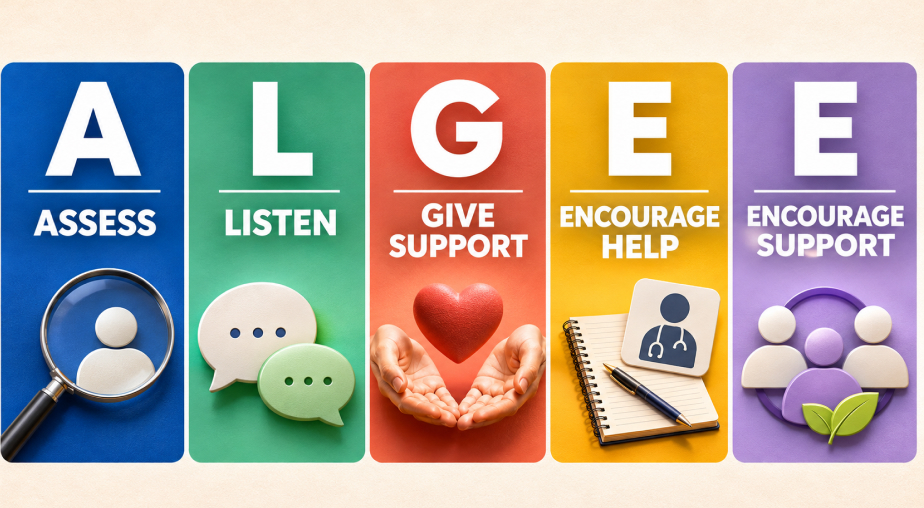
The course uses a five-step action framework known as ALGEE.
Mental Health First Aid Step
Purpose In An Athletics Setting
A — Approach and assess
Recognize possible concerns, approach respectfully, and assess whether immediate safety assistance is needed
L — Listen nonjudgmentally
Give a student space to explain their experience without criticism or assumptions
G — Give reassurance and information
Respond supportively and share appropriate, reliable information
E — Encourage professional help
Help the student identify qualified campus or community mental health services
E — Encourage self-help and other support strategies
Recognize appropriate personal, family, peer, and community support alongside professional care
The framework is intended to guide initial supportive responses, not to replace clinical evaluation.
For example, a coach who notices a concerning change in a student’s behavior can initiate a private, respectful conversation and explain available resources.
The coach should avoid making assumptions about a particular mental health condition, promising absolute confidentiality, or attempting to provide therapy.
When immediate safety concerns arise, the appropriate response is to follow institutional emergency procedures and seek qualified assistance.
The program also teaches participants to consider their own well-being, recognizing that supporting students through difficult experiences can create responsibilities and emotional demands for athletics staff.
Katie Bell Emphasizes The Importance Of Mental Health Education
Katie Bell’s leadership connects the training initiative with California Lutheran’s broader responsibilities for student-athlete development.
Bell joined Cal Lutheran as associate athletic director and senior woman administrator in July 2025 after working at St. Joseph’s University–Brooklyn and Chapman University.
Her professional background includes athletics administration, compliance, student-athlete services, and advising student-athlete leadership groups.
She also competed in women’s soccer at Chapman University.
According to her official California Lutheran staff profile, Bell previously supported student-athlete development and life-skills programming, experience relevant to the responsibilities involved in coordinating athletics education. California Lutheran University
The October announcement positioned mental health literacy as an additional responsibility for people already involved in student-athlete support.
This matters because athletics departments often contain several overlapping relationships.
Coaches manage training and competition. Athletic trainers address sports-related healthcare needs within their professional scope. Administrators coordinate policies, resources, and student services.
Mental Health First Aid can help these professionals understand when a student may need additional support and how to direct that student toward appropriate services.
It does not make these roles interchangeable.
A coach who completes the course remains a coach, not a licensed mental health clinician.
Similarly, an administrator’s completion of training does not establish that the university has increased its counseling capacity or reduced waiting times for appointments.
The educational value lies in improving recognition, communication, and referral awareness.
Elizabeth Brooks Connects Athlete Mental Health With Personal Experience
California Lutheran Interim Associate Vice President and Athletic Director Elizabeth Brooks also contributed to the university’s October announcement.
Brooks described experiencing grief, depression, and anxiety after the unexpected death of her mother before her freshman year at Cal Lutheran.
She recalled receiving understanding from her coaches, teammates, and family during a difficult period.
Her account illustrates how athletic relationships can influence whether students feel comfortable acknowledging personal challenges.
Brooks also discussed receiving professional therapy and encouraged students to use campus resources, including Counseling and Psychological Services and Spiritual Care.
Her experience is an individual account, not evidence that any particular treatment will produce the same outcome for another person.
It nevertheless highlights a distinction that matters in athletics: supportive relationships and professional mental health services can serve complementary purposes.
Coaches and teammates may offer encouragement, flexibility, and a sense of connection.
Qualified mental health professionals provide assessment and treatment when those services are needed.
The National Institute of Mental Health’s guidance on caring for mental health explains when people should consider seeking professional assistance, particularly when symptoms persist or interfere with daily functioning.
For student-athletes, access to support can become especially important when personal difficulties coincide with academic deadlines, training demands, injuries, or major life changes.
Brooks’ willingness to discuss her experience may help normalize conversations within the athletics department, but personal disclosure should always remain voluntary.
Student-athletes should not feel required to reveal sensitive medical information to coaches or teammates to receive appropriate support.
Volleyball Coach Kellee Roesel Encourages Athletes To Seek Professional Support
California Lutheran head women’s volleyball coach Kellee Roesel also discussed the importance of mental health in the university’s announcement.
Roesel emphasized that emotional well-being deserves attention alongside physical health.
She drew a comparison between seeking assistance for physical injuries and recognizing when professional mental health support may be appropriate.
The comparison is relevant to college athletics because student-athletes are often familiar with consulting athletic trainers, physicians, and rehabilitation specialists.
Mental health concerns may be less visible, and some students may hesitate to raise them because of perceived stigma, privacy concerns, or uncertainty about how coaches will respond.
Roesel also shared her experience of seeking therapy following the death of her husband in 2017.
Her public account reflects an effort to encourage students to view professional mental health care as a legitimate form of support.
However, the practical implications extend beyond individual stories.
Athletics departments need procedures that help coaches respond appropriately when students disclose personal difficulties.
These procedures should address confidentiality, professional boundaries, available services, and circumstances requiring urgent intervention.
Coaches can help create environments where seeking assistance is accepted, but they should not pressure students to discuss sensitive experiences publicly.
A student’s decision to pursue counseling should also be treated separately from assumptions about athletic commitment, playing ability, or competitive motivation.
NCAA Division III Expands Mental Health First Aid Training Across Colleges
California Lutheran’s training forms part of a broader NCAA initiative to improve mental health literacy among athletics personnel.
In August 2025, NCAA Division III announced a partnership with the National Council for Mental Wellbeing to offer fully funded Mental Health First Aid training to participating institutions.
The program prioritizes head coaches and athletic trainers, although other eligible athletics staff can participate.
The NCAA established the initiative to help institutions recognize possible mental health challenges, improve supportive responses, and reduce stigma around seeking assistance.
According to the NCAA’s Division III training announcement, the program runs through August 1, 2027. The Official Website of the NCAA
The current NCAA program provides several defined training opportunities.
NCAA Program Detail
Official Information
Participating divisions
NCAA Division II and Division III
Training partner
National Council for Mental Wellbeing
Eligible participants
Up to 30 athletics staff members per institution
Course length
7.5 hours
Certification
Mental Health First Aid for Higher Education
Certification duration
Three years
The NCAA expanded the funded training opportunity to Division II in August 2026, with a formal announcement on September 3.
The association has identified the program as one way to support implementation of its broader student-athlete mental health guidance.
Importantly, these figures describe the NCAA’s general program structure. California Lutheran did not disclose how many people completed its specific August 10 session.
The national expansion shows growing institutional attention to mental health education, but participation in a training program should not be interpreted as proof that an institution has resolved all barriers to mental healthcare.
Why College Coaches Need Mental Health Awareness Training
College student-athletes navigate overlapping responsibilities that may include academics, competition, travel, relationships, finances, and planning for life after graduation.
These experiences vary considerably among students.
Some athletes may find participation in sports supportive and rewarding, while others may experience periods of pressure or difficulty.
Coaches frequently interact with student-athletes over extended periods, making them important participants in the campus support environment.
The NCAA’s 2022 Coach Well-Being Study found that more than 80% of surveyed coaches reported spending more time discussing mental health with student-athletes than before the COVID-19 pandemic.
The association also identified supporting student-athlete mental health as a major issue facing coaching staffs.
These findings are discussed in the NCAA Mental Health First Aid program overview. The Official Website of the NCAA
They help explain why structured education may be useful.
Coaches may be asked to respond to concerns involving stress, emotional difficulties, or substance use without having received formal training in supportive communication or referral procedures.
Mental Health First Aid provides a framework for responding within appropriate professional boundaries.
Nevertheless, the program cannot eliminate every challenge associated with athlete mental health.
A student may need specialized clinical services, ongoing treatment, academic accommodations, or support beyond the athletics department.
Coaches must therefore understand not only how to recognize possible concerns but also when to involve appropriately qualified professionals.
Training Must Be Supported By Confidentiality And Access To Care
An important question for California Lutheran and other universities is what happens after an athlete decides to seek assistance.
Mental health awareness is valuable, but students also need accessible and trustworthy support systems.
An effective institutional approach should make it clear how student-athletes can contact counseling services, what information may remain private, and how staff respond to urgent concerns.
Confidentiality deserves particular attention because coaches may have influence over playing time, team participation, or other athletic decisions.
Students should understand the difference between speaking with a coach and consulting a licensed mental health professional.
The privacy protections and reporting obligations associated with these relationships may differ.
Athletics personnel should avoid promising confidentiality beyond what their institutional policies and legal responsibilities allow.
The NCAA’s Mental Health Best Practices provide a broader framework for supporting student-athletes through institutional procedures, qualified care, education, and appropriate coordination. The Official Website of the NCAA
Mental Health First Aid training can contribute to this framework, but it is only one component.
A university should also consider whether students know how to obtain appointments, whether referral processes are clear, and whether athletes can seek support without inappropriate pressure to disclose personal medical information.
California Lutheran’s October announcement identifies existing campus resources and emphasizes encouraging students to use them.
It does not provide new data about counseling capacity, appointment availability, or changes in student mental health outcomes.
Those questions remain important for assessing the practical impact of the initiative.
What Other College Athletics Departments Can Learn From California Lutheran
California Lutheran’s experience offers a useful example for smaller universities and NCAA Division III athletics departments.
The institution brought coaches and administrators into the same educational program rather than treating mental health awareness as a responsibility belonging exclusively to counseling personnel.
This approach may help establish more consistent expectations across athletic programs.
A basketball coach, volleyball coach, athletic trainer, and administrator may encounter different situations, but all can benefit from understanding how to respond respectfully and direct students toward appropriate services.
The training also emphasizes that supportive communication is a skill that can be developed.
Adults working with athletes should be able to listen without immediately dismissing concerns, assigning blame, or assuming that a student’s difficulties reflect poor motivation.
At the same time, completing Mental Health First Aid should not become a substitute for investing in qualified mental health professionals.
Universities considering similar initiatives can evaluate whether staff training is accompanied by accessible services, clearly defined responsibilities, and procedures for responding to urgent concerns.
They can also consider how students themselves experience the support environment.
For example, confidential feedback may help institutions understand whether athletes know where to seek assistance and whether they feel comfortable approaching appropriate staff.
Such evaluation would provide more meaningful information than training completion alone.
What Student-Athletes Should Understand About Mental Health First Aid
For student-athletes at California Lutheran and other universities, the expansion of Mental Health First Aid training represents an effort to make athletics personnel better prepared to respond to concerns.
It does not mean every coach is qualified to provide mental health treatment.
Students experiencing emotional difficulties may benefit from speaking with a trusted adult, but they should also know how to access qualified professionals when appropriate.
Mental health challenges can arise for many reasons and should not automatically be attributed to competitive pressure, academic responsibilities, or participation in sports.
Persistent changes in mood, behavior, sleep, or daily functioning may warrant professional evaluation.
Students should not feel obligated to disclose personal medical histories to teammates or coaching staff.
If a student is concerned about privacy, a campus counseling service or qualified healthcare professional can explain applicable confidentiality protections and their limits.
In the United States, the 988 Suicide & Crisis Lifeline provides crisis support. Immediate life-threatening emergencies require emergency services.
The purpose of Mental Health First Aid is to help people recognize when support may be needed and respond appropriately—not to shift responsibility for clinical care onto coaches or student-athletes themselves.
California Lutheran’s Next Challenge Is Turning Training Into Everyday Support
California Lutheran University’s October 10 announcement documents a concrete step toward improving mental health awareness within its athletics department.
The August 10 training brought coaches and administrators together through an NCAA-sponsored program led locally by Katie Bell.
Elizabeth Brooks and Kellee Roesel also contributed personal perspectives emphasizing the importance of supportive relationships and access to professional care.
Together, their accounts illustrate how athletics leadership can encourage conversations about mental well-being while recognizing the limits of nonclinical support.
The broader NCAA initiative provides a structured opportunity for Division II and Division III institutions to develop similar skills.
However, the long-term value of the training will depend on how consistently athletics departments apply those skills, maintain professional boundaries, and connect students with appropriate services.
California Lutheran has not reported clinical outcome data demonstrating improvements following the training. Future evaluation could help establish whether students experience clearer referral pathways, greater confidence in seeking assistance, or better access to appropriate care.
For college athletics, the central lesson is that supporting student-athlete mental health requires more than recognizing its importance.
It involves preparing the adults who interact with athletes, establishing trustworthy procedures, and ensuring that professional mental health care remains accessible when students need it.