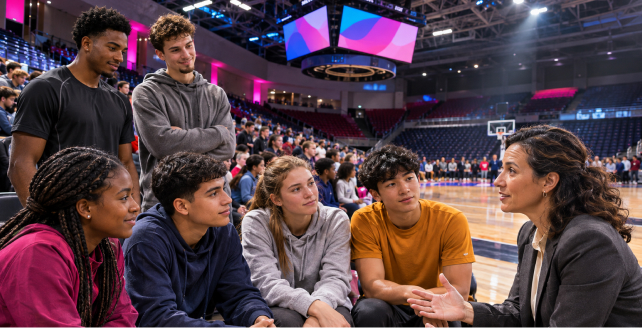
The University of Dayton Flyers and CareSource brought 1,600 students from 28 Dayton-area middle and high schools to UD Arena on October 15, 2026, for a youth mental health awareness event combining basketball, personal stories, and conversations about seeking support. The gathering also delivered $30,000 in grants to three local schools for mental health programming.
The event was organized through the CareSource Mental Health Games, an initiative focused on adolescent and young adult mental health and suicide prevention.
Dayton men’s basketball head coach Anthony Grant, his wife Chris Grant, Flyers student-athletes, and local mental health experts participated in a program designed to encourage young people to speak openly about emotional challenges and recognize when professional support may be needed.
The discussion was moderated by Brandon Saho, a mental health advocate known for creating conversations about psychological well-being.
According to CareSource’s October 21 announcement, the gathering emphasized a message that young people should not feel ashamed of experiencing mental health difficulties or asking for assistance. CareSource
The initiative demonstrates how collegiate athletics can provide a platform for youth mental health education beyond the basketball court.
However, the event was an awareness and community engagement activity, not a clinical intervention. Its attendance figures and funding commitments establish its reach, but they do not demonstrate measurable improvements in participants’ mental health.
Dayton Flyers Welcome 1,600 Students To UD Arena For Mental Health Awareness
On Thursday, October 15, 2026, UD Arena in Dayton, Ohio, became the setting for an event focused on conversations that extend beyond athletic competition.
CareSource, a nonprofit managed care organization headquartered in Dayton, partnered with University of Dayton Athletics to welcome students from 28 regional middle and high schools.
The program combined basketball-related activities with discussions about emotional well-being, mental health resources, and the importance of seeking help.
Dayton Flyers men’s basketball student-athletes interacted with younger participants, including through on-court competitions.
Anthony and Chris Grant addressed attendees, while a panel of local mental health experts participated in a discussion moderated by Brandon Saho.
The combination of familiar athletic activities and personal conversations was intended to make mental health education more approachable for students.
The event was held ahead of the October 17 charity exhibition basketball game between Dayton and Notre Dame, which supported the Jay’s Light initiative.
| Event Detail | Verified Information |
|---|---|
| Date | October 15, 2026 |
| Location | UD Arena, Dayton, Ohio |
| Organizers | CareSource and University of Dayton Athletics |
| Student attendance | 1,600 |
| Participating schools | 28 Dayton-area middle and high schools |
| Featured participants | Anthony Grant, Chris Grant, Dayton Flyers athletes, local mental health experts |
| Discussion moderator | Brandon Saho |
| School grants | Three awards of $10,000 each |
These details were confirmed in the official CareSource event report.
The gathering provided an opportunity for students to hear from recognizable figures in college basketball while learning that mental health challenges deserve the same seriousness and respect as physical health concerns.
For schools, the event also illustrated how partnerships with universities and community organizations can introduce students to resources outside the classroom.
Anthony Grant Shares The Purpose Behind Jay’s Light
Anthony Grant’s involvement reflects a deeply personal commitment to youth mental health awareness.
Grant has served as the University of Dayton men’s basketball head coach since 2017 and has worked with CareSource to support conversations about adolescent and young adult mental health.
The initiative is connected to Jay’s Light, a fund created in memory of Anthony and Chris Grant’s daughter, Jayda Grant, who died in 2022 at age 20.
The family has used the initiative to support mental health awareness and suicide prevention, particularly among young people.
At the October 15 gathering, Anthony Grant discussed the purpose of Jay’s Light and encouraged students to recognize the importance of seeking assistance when facing emotional difficulties.
His participation added a personal dimension to the program, connecting a prominent college basketball figure with a broader public health issue.
The University of Dayton’s announcement of its 2026 charity exhibition describes the continuing partnership between the Grant family, Dayton Athletics, and CareSource. University of Dayton Athletics
The family’s experience should be discussed respectfully, without speculation about private medical circumstances or suggesting that one personal tragedy explains the experiences of other young people.
The broader significance of Jay’s Light lies in its efforts to encourage open discussion and direct attention toward appropriate support resources.
Mental health difficulties can affect young people from many backgrounds, including students who participate in sports, perform well academically, or appear socially connected.
No single experience, achievement level, or outward behavior can establish whether someone is struggling.
That is why awareness efforts should emphasize listening, professional support, and the importance of taking concerns seriously.
Three Dayton-Area Schools Receive $30,000 For Mental Health Programs
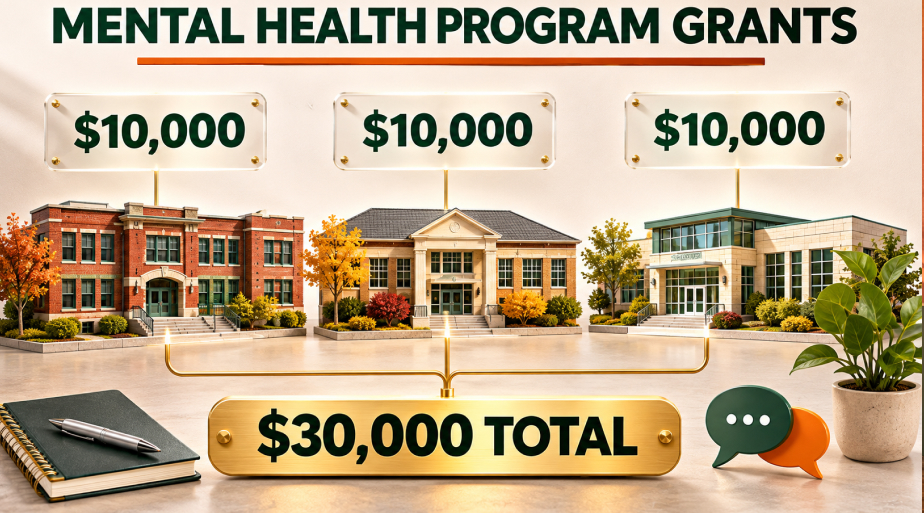
One of the event’s most concrete outcomes was the announcement of three school grants totaling $30,000.
CareSource awarded $10,000 each to three Dayton-area educational institutions through Healthy Minds, Bright Futures, a program supported by the CareSource Foundation.
The recipients were National Trail Local Schools, West Carrollton Middle School, and Chaminade Julienne Catholic High School.
According to CareSource, the funding is intended to support mental health programming in these school communities.
Local television reporting also indicated that schools submitted proposals explaining how they would use the funding to support mental health initiatives.
The grants are important because they connect the awareness event with financial resources that schools can potentially use after the gathering ends.
However, the official announcement does not provide detailed budgets, implementation schedules, or independently evaluated outcomes for the three awards.
It would therefore be premature to claim that the grants have already increased access to counseling or reduced mental health difficulties among students.
The value of the funding will depend partly on how each school implements its proposed activities and evaluates their effectiveness.
Potential school mental health initiatives can involve educational programming, staff training, partnerships with qualified providers, or improved information about available services.
Those examples represent general possibilities, not confirmed spending plans for the three grant recipients.
For communities considering similar partnerships, the Dayton model highlights the importance of connecting public awareness with practical resources.
An event may introduce students to important messages, but schools also need sustainable systems for responding when a young person requests assistance.
Why Youth Mental Health Education Remains Important In 2026
The Dayton event took place during a period of heightened national attention to adolescent mental health.
In September 2026, the Centers for Disease Control and Prevention released updated findings from the 2025 Youth Risk Behavior Survey, providing a more recent picture of mental health among American high school students.
The data showed improvements in several indicators between 2023 and 2025, although substantial challenges remained.
According to the CDC’s 2026 youth health report, the percentage of high school students reporting persistent sadness or hopelessness decreased from 40% in 2023 to 33% in 2025.
The proportion reporting poor mental health decreased from 29% to 23%, while the percentage seriously considering suicide decreased from 20% to 14%. CDC Newsroom
These findings indicate meaningful national improvements, but they do not mean that adolescent mental health concerns have been resolved.
Approximately one-third of high school students continued to report persistent feelings of sadness or hopelessness in 2025.
The CDC also reported that 15.4% of high school students had an unmet perceived need for counseling or therapy, according to a separate analysis of the 2025 survey. cdc.gov
That finding illustrates why mental health awareness must be accompanied by attention to access.
Students may recognize that they need help but encounter difficulties obtaining appropriate services.
Potential barriers can include cost, transportation, scheduling, availability of qualified providers, concerns about privacy, and uncertainty about where to begin.
The Dayton gathering cannot resolve these challenges on its own.
Nevertheless, events that encourage young people to identify trusted adults and learn about available resources may complement broader efforts to improve school and community support.
The CDC’s findings are national estimates and should not be interpreted as mental health statistics for the 1,600 students attending the Dayton event.
College Basketball Provides A Platform For Mental Health Conversations
College sports occupy a visible position in many American communities.
Universities attract attention through athletic competition, and student-athletes can become recognizable figures for younger students who follow their teams.
The University of Dayton and CareSource used that connection to create an educational gathering inside a familiar sports venue.
Rather than separating mental health education from athletics, organizers incorporated the discussion into a basketball-centered experience.
Students participated in on-court activities, interacted with Dayton Flyers players, and heard from adults discussing mental health and support.
This approach may make an awareness event more engaging for students who would not ordinarily attend a standalone mental health seminar.
It also offers an opportunity to challenge the assumption that athletic achievement and psychological well-being are unrelated.
However, college athletes should not be expected to act as mental health clinicians simply because they are visible role models.
Their appropriate contribution may involve encouraging respectful conversations, sharing general experiences when they choose, and directing students toward qualified support.
The distinction between awareness and treatment is essential.
A student-athlete can help normalize asking for assistance, but diagnosing a condition, evaluating suicide risk, or providing therapy requires appropriately trained professionals.
For university athletics departments, the Dayton initiative illustrates a community engagement role that can complement existing sports medicine, counseling, and student wellness services.
CareSource Mental Health Games Extend Beyond Dayton
The October 15 gathering was part of a larger partnership that began in 2023.
The CareSource Invitationals use college basketball events to increase awareness of adolescent and young adult mental health, with particular attention to suicide prevention.
According to CareSource, the broader series has engaged more than 10,000 high school students and reached more than 100,000 college basketball fans nationwide.
These figures describe event engagement and audience reach, not clinical outcomes.
The Dayton event was also part of a wider sequence of October 2026 activities.
On October 6, CareSource organized another mental health awareness gathering at Walnut Hills High School in Cincinnati, Ohio.
That event brought together 1,200 students and included participation from University of Cincinnati men’s basketball coach Jerrod Calhoun, Xavier University men’s basketball coach Richard Pitino, and members of their teams.
The CareSource announcement about the Cincinnati event described activities centered on support, resilience, and asking for help. CareSource
Together, the Cincinnati and Dayton gatherings demonstrate how the organization has incorporated mental health education into different collegiate basketball communities.
The model combines sports participation, recognizable athletic figures, school involvement, and community partnerships.
Its effectiveness should ultimately be evaluated through more than attendance.
Useful measures could include whether students understand where to seek help, whether schools can connect students with qualified services, and whether grant-funded initiatives produce meaningful improvements in access.
Dayton’s Charity Basketball Game Adds Another Dimension To The Initiative
Two days after the student mental health gathering, the University of Dayton hosted Notre Dame in its annual CareSource Spotlight charity exhibition.
The game took place on October 17, 2026, at UD Arena.
The Flyers defeated Notre Dame 75–65, overcoming a 38–33 halftime deficit.
Junior Malcolm Thomas led Dayton with 20 points and six rebounds, while Landen Joseph contributed 15 points.
The university’s official game recap confirmed the result. University of Dayton Athletics
The exhibition was organized to benefit Jay’s Light, with the university announcing that net proceeds from ticket sales would support the initiative.
The game represented the fourth year of the partnership between CareSource and Dayton men’s basketball.
Its connection to the October 15 gathering demonstrates how organizers combined a school-focused educational event with a larger college basketball fundraiser.
The official sources reviewed did not establish a final fundraising total from the October 17 game, so no amount should be assumed.
The partnership’s longer-term importance will depend on how awareness, fundraising, and school support are translated into accessible resources.
School Connectedness Can Complement Mental Health Education
The Dayton event’s emphasis on encouragement and asking for help is consistent with broader public health guidance about supportive school environments.
The CDC describes school connectedness as the experience of feeling cared for, supported, and valued by adults and peers at school.
According to the agency’s school connectedness guidance, stronger school connections are associated with lower risks of poor mental health and several other adverse outcomes. CDC
This does not establish that attending a sports-based awareness event will improve an individual student’s mental health.
It does suggest that relationships and supportive environments are important considerations for schools.
A successful mental health education program should help students understand that they can speak with trusted adults without being judged.
Schools can also work to make information about counseling, crisis support, and community services accessible and understandable.
For younger students, age-appropriate explanations are especially important.
Middle school students may have different levels of understanding and different support needs from older adolescents.
Educational messages should therefore avoid assuming that every student has the same experiences or can access help in the same way.
Parents, teachers, school counselors, and qualified healthcare professionals all have distinct roles.
A supportive school environment makes room for those roles without expecting peers or athletic mentors to handle serious mental health concerns independently.
What Schools And Families Can Learn From The Dayton Initiative
The partnership between CareSource and University of Dayton Athletics provides a practical example of how community organizations can collaborate on youth mental health awareness.
The event brought students together in an engaging environment, introduced them to mental health professionals, and used college basketball to support conversations about seeking help.
It also directed funding toward three schools, giving the initiative a component that extends beyond the gathering itself.
For schools, one important lesson is that mental health awareness should connect students with clear, accessible information about where support is available.
An assembly can encourage discussion, but students need to know what happens when they approach a trusted adult or request professional assistance.
For families, the event reinforces the importance of taking young people’s emotional concerns seriously without immediately making assumptions about diagnoses.
Listening, maintaining supportive communication, and seeking qualified guidance when concerns persist can help young people access appropriate assistance.
For coaches and athletics departments, the initiative highlights how sports can provide opportunities for mentorship and community education.
Those opportunities should complement, rather than replace, professional mental health services.
The CDC’s updated school mental health guidance recommends approaches that strengthen mental health literacy, supportive relationships, emotional and problem-solving skills, and appropriate referral practices. CDC
Schools considering similar events should also plan how to respond when a student discloses a serious concern.
Staff need appropriate training, clear referral procedures, and an understanding of confidentiality and safeguarding responsibilities.
Students should not be asked to disclose private mental health experiences publicly or feel pressured to share personal stories.
When Young People Need More Than Mental Health Awareness
Mental health education can encourage recognition and help-seeking, but it is not a substitute for assessment or treatment.
Young people experiencing persistent emotional distress, significant changes in behavior, or difficulty functioning at school or home may benefit from evaluation by a qualified healthcare professional.
Parents and caregivers can contact a pediatrician, school mental health professional, or licensed mental health clinician to discuss concerns.
If a young person expresses thoughts of suicide or immediate safety concerns, the situation requires prompt attention rather than reliance on general wellness advice.
In the United States, the 988 Suicide & Crisis Lifeline offers free, confidential crisis support by call, text, or online chat. Life-threatening emergencies require emergency services.
The most important distinction is that asking for help should lead to an appropriate response.
A community event can introduce that message, but families, schools, and healthcare systems must help ensure support is available when someone needs it.
Dayton’s Mental Health Partnership Shows How Sports Can Support Community Wellness
The October 15 event at UD Arena demonstrated the reach of a community mental health initiative built around college basketball.
By bringing together 1,600 students from 28 schools, the Dayton Flyers and CareSource created an opportunity for young people to hear about emotional well-being, connect with college athletes, and learn the importance of seeking assistance.
Anthony and Chris Grant’s involvement connected the gathering to Jay’s Light, while the $30,000 in school grants provided additional support for local mental health programming.
The October 17 charity exhibition against Notre Dame extended the partnership’s visibility through another major university athletics event.
The initiative’s strongest documented achievements are its participation, community engagement, and funding commitments.
Its longer-term impact on student mental health remains an important question requiring appropriate evaluation.
For schools, families, and sports organizations, the Dayton example illustrates how athletics can contribute to youth wellness when awareness is paired with responsible education, professional support pathways, and sustained community investment.
The central message extends beyond basketball: young people deserve environments where mental health concerns are taken seriously, asking for assistance is encouraged, and appropriate support is available when needed.