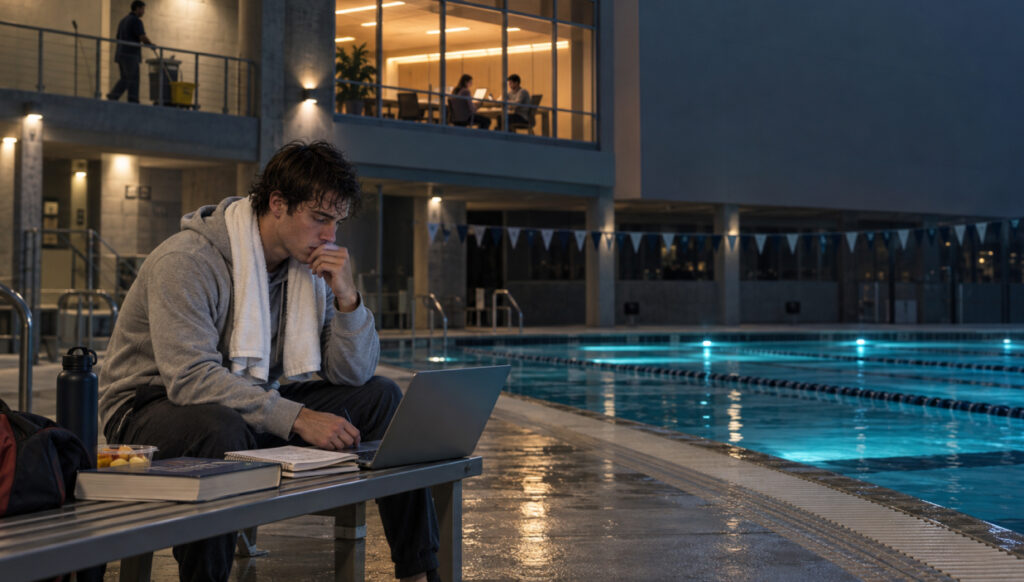
A student-athlete’s day does not divide neatly into an academic half and an athletic half.
A difficult morning lecture can follow someone into afternoon training. Soreness from practice can still be present while they prepare for an exam. Worry about competition can sit beside an unfinished assignment. By bedtime, the athlete may be carrying fatigue, academic stress, performance concerns and repetitive thoughts from several parts of the same day.
New research published September 7, 2026 in Frontiers in Psychology provides an unusually detailed look at how some of those experiences can coexist and change across a day.
Researchers Aozhou Wang, Can Ao, Nongqin Guan and Cong Ma followed students in sport-related university majors for 14 consecutive days. Rather than asking participants to remember how stressed they had been over the previous month, the researchers prompted them by smartphone in the morning, midday and evening.
The findings should be interpreted carefully. The final sample included only 60 students ages 18 to 22 at one university in Chongqing, China, so this is not evidence that every U.S. college athlete experiences stress in the same way. The study was also observational and cannot show that one type of stress caused another.
But its central idea is useful far beyond that particular campus: physical strain, academic demands, performance worry, mood, rumination, concentration and sleep can occupy the same daily system rather than functioning as unrelated problems.
For athletes, coaches, parents and college support staff, that changes an important question.
Instead of asking only, “Is this school stress or sports stress?” it may sometimes be more useful to ask, “What has this person been carrying across the entire day?” The Practical Guide to Recovery & Resilience After Setbacks.
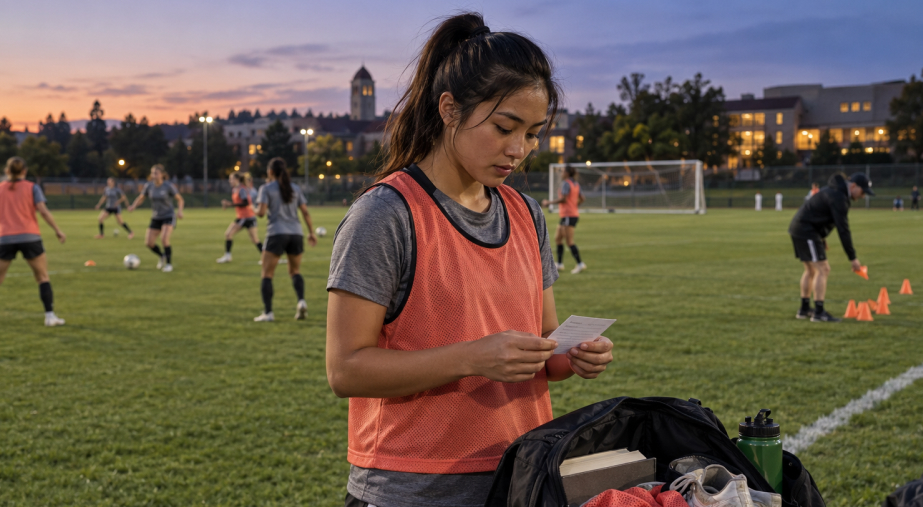
Researchers Checked In Three Times A Day
The study used a method known as ecological momentary assessment, or EMA.
Researchers originally recruited 72 students. After protocol and response-quality screening, the final analytic sample contained 60 participants: 35 men and 25 women. They represented both individual and team sports and were in their first through third years of university.
For 14 days, participants received smartphone assessments during three windows:
- 7–9 a.m.
- 1–3 p.m.
- 9–11 p.m.
That produced a balanced analytic panel of 2,520 observations.
At each assessment, students rated eight immediate experiences: fatigue, soreness or bodily pain, academic stress, training or competition worry, depressed mood, tension/anxiety/irritability, repetitive negative thinking or rumination, and difficulty concentrating.
Previous-night sleep was assessed separately each morning.
This design matters because stress is dynamic.
A questionnaire asking, “How stressed were you this month?” can provide valuable information, but it compresses many different days into one answer. A morning exam, an afternoon practice and a late-evening study session disappear into an average.
Repeated assessments give researchers another view: what is happening right now, and how does that pattern change several hours later?
The full daily stress study is particularly careful about what those patterns can and cannot establish.
They reveal associations.
They do not prove a causal chain.
Physical And Mental Demands Did Not Stay In Separate Lanes
One of the more interesting findings involved physical burden.
Within the study’s temporal network, soreness and fatigue had the most prominent outgoing structural positions. In practical terms, higher soreness at one assessment was conditionally associated with higher levels of several measured states at a later assessment, including performance worry and fatigue.
That does not mean muscle soreness causes mental-health problems.
It does suggest that separating physical recovery completely from psychological and academic functioning may miss part of the daily picture.
Imagine an athlete finishing a demanding afternoon session.
Their legs are sore.
They are physically tired.
Tomorrow’s competition is on their mind.
They still have two hours of coursework waiting.
Those demands do not have to occur independently simply because one belongs to sport and another belongs to school.
The athlete experiences all of them through the same evening.
Academic Stress Can Travel Into Athletic Time
The reverse matters too.
Academic pressure does not automatically disappear when practice begins.
An athlete may be physically present at training while thinking about an examination, presentation, missed class, group project or deadline.
That does not necessarily mean the athlete has poor focus or lacks commitment.
It means people do not have an internal switch that completely isolates one role from another.
Earlier NCAA data make this especially relevant to U.S. college sports.
The NCAA Student-Athlete Health and Wellness Study was distributed to about 23,000 NCAA student-athletes across all three divisions during 2022-23. Among its mental-health findings, the NCAA identified academics, planning for the future and finances as the biggest stressors affecting student-athlete mental health.
That does not establish that academic stress produces a particular mental-health condition.
It does show why academics should not be treated as background noise when discussing athlete well-being.
For a student-athlete, school is part of the performance environment too.
The Evening Can Become A Convergence Point
The evening is especially interesting because several parts of the day may finally meet there.
Classes may be finished.
Practice may be over.
But the demands themselves may not be finished.
There can still be homework.
Recovery.
Eating.
Travel.
Messages from teammates.
Preparation for tomorrow.
Physical soreness.
Competition thoughts.
And the need to sleep.
In the Frontiers study, the evening assessment occurred between 9 and 11 p.m. Participants were not simply asked whether the day had been stressful. They rated what they were experiencing at that moment.
This helps illustrate why “just relax after practice” can be unrealistic advice.
Recovery requires time and opportunity.
An athlete who leaves training and immediately begins academic work may have little transition between physical effort and cognitive effort.
That does not mean every athlete needs the same evening routine. It does mean recovery plans should reflect the actual structure of the athlete’s day rather than an idealized schedule.
Rumination May Connect Different Parts Of The Day
Rumination was another prominent variable in the study.
In the contemporaneous network, the combined tension/anxiety/irritability indicator and rumination had particularly prominent positions.
Rumination generally refers to repetitive thinking that can become difficult to disengage from.
In an athlete’s evening, that might involve repeatedly replaying an error from practice.
Or thinking about tomorrow’s exam.
Or worrying about selection.
Or returning mentally to an uncomfortable conversation.
The study does not establish that rumination causes the other states in its network. The researchers explicitly warn against interpreting structural prominence as causal priority.
That distinction is important.
A network diagram can show that variables are connected statistically without revealing a simple sequence such as:
stress → rumination → poor sleep → worse performance.
Real life is usually less tidy.
The useful takeaway is narrower: when an athlete seems overloaded, looking only at the most visible stressor may overlook other experiences occurring alongside it.
Poorer Sleep Was Followed By A Harder Morning
The study’s sleep findings provide another important piece.
Researchers compared nights when a participant reported poorer sleep than was usual for that individual with that person’s next-morning ratings.
Poorer-than-usual sleep was prospectively associated with higher next-morning levels of all eight measured states, even after statistical adjustment for the previous evening’s level of the same outcome, study day and individual differences in sleep.
The largest associations were seen for academic stress, tension/anxiety/irritability and rumination.
Academic stress had a coefficient of 1.00 with a 95% confidence interval of 0.82 to 1.18. The tension/anxiety/irritability measure was 0.82, while rumination was 0.61.
Positive associations were also observed for fatigue, performance worry, depressed mood, soreness and concentration difficulty.
Those numbers require restraint.
They do not mean one poor night of sleep causes depression, anxiety or academic failure. The researchers specifically describe the findings as prospective associations rather than causal effects.
Unmeasured factors could influence both sleep and the following morning.
Still, the pattern reinforces an important practical point: sleep sits at the intersection of academic, athletic, physical and psychological life.
Sleep Should Not Become Another Performance Demand
Athletes already receive plenty of instructions about sleep.
Get to bed earlier.
Put the phone away.
Recover properly.
Be disciplined.
Those recommendations can become counterproductive when they ignore why someone is awake.
A student may have returned late from competition.
They may have an early class.
They may be finishing coursework after practice.
They may work for pay.
They may be dealing with an injury.
They may have a roommate whose schedule differs from theirs.
They may simply be having difficulty sleeping despite trying to maintain reasonable habits.
The new study should therefore not be reduced to “athletes need to sleep better.”
Its more useful implication is that sleep can provide information about how multiple demands are interacting.
If poor sleep repeatedly occurs alongside academic overload, late training, travel or persistent distress, the answer may require examining the surrounding schedule rather than simply demanding more sleep discipline.
A Difficult Practice Can Affect The Study Session That Comes Next
College sports often talk about recovery in physical terms.
Hydration.
Nutrition.
Mobility.
Rest.
Treatment.
Those elements matter, but recovery also occurs within a student schedule.
An athlete may leave practice physically fatigued and immediately need to concentrate on complex academic material.
The Frontiers researchers found fatigue and soreness occupying important positions in the daily network. Concentration difficulty was another repeatedly measured state.
The study does not prove that reducing training load would improve grades, nor does it provide a formula for changing practice.
Training decisions depend on the sport, athlete, competitive calendar, health status and qualified coaching and healthcare judgment.
But it supports asking a broader question:
What is expected of this athlete after training ends?
That question can reveal demands that are invisible when a team evaluates practice in isolation.
Academic Support And Athlete Support Should Communicate
Universities frequently divide services according to administrative function.
Academic advisers handle academics.
Coaches handle sport.
Athletic trainers handle physical health.
Counselors handle mental health.
Strength staff handle physical preparation.
Each specialization has a purpose.
The athlete, however, is one person moving between all of them.
The Frontiers authors specifically note that coordination among academic, sport-support and mental-health personnel may be useful when concerns cross physical, academic, performance, emotional and cognitive domains.
That does not mean everyone should have unrestricted access to an athlete’s private information.
Privacy and professional boundaries remain important.
Coordination can instead mean building systems where an athlete does not have to repeatedly explain the same overload to five disconnected departments.
Coaches May Notice The Athletic Part First
A coach might notice that an athlete seems unusually distracted during practice.
The easiest explanation is performance-based:
They are not focused.
They need to concentrate.
They need more discipline.
Sometimes that may be appropriate.
But the observable behavior does not reveal its cause.
The athlete might have slept poorly.
They might have an examination tomorrow.
They might be worried about finances.
They might be sore.
They might be dealing with a relationship problem.
They might have a mental-health concern requiring qualified care.
Or they might simply be having one difficult afternoon.
This is why recognition should not become amateur diagnosis.
The NCAA Mental Health Best Practices recommend healthy environments, validated mental-health screening, written referral pathways and licensed professionals for formal evaluation and treatment.
The guidance also explicitly recognizes coaches and other non-clinical staff as people who may notice concerns without being responsible for diagnosing them.
A coach can ask what is going on.
They do not need to decide clinically why it is happening.
One Bad Evening Is Not A Mental-Health Disorder
This boundary is essential.
The Frontiers researchers used brief momentary indicators.
Participants reported experiences such as depressed mood or tension/anxiety/irritability at particular moments.
Those measurements were not clinical diagnoses.
The researchers specifically state that the study’s single-item measures were not substitutes for validated multidimensional clinical scales.
That matters because normal human life contains unpleasant emotions.
Athletes become tired.
Students become stressed before exams.
Competitors worry about performance.
People become irritable after difficult days.
An evening containing several of these experiences does not automatically indicate a psychiatric disorder.
Concern becomes more important when difficulties are persistent, severe, worsening, interfering substantially with daily functioning or raising questions about safety.
At that point, assessment belongs with an appropriately qualified healthcare or mental-health professional.
Monitoring Patterns May Be More Useful Than Judging Individual Moments
One advantage of the 14-day study is that it shifts attention from isolated moments toward patterns.
A single bad practice tells us little.
A single poor night’s sleep tells us little.
A stressful examination week is not automatically evidence of a larger problem.
But repeated patterns may be worth noticing.
Does the athlete repeatedly reach evening exhausted and unable to complete coursework?
Does sleep consistently deteriorate around travel?
Does academic stress intensify during competition periods?
Does soreness remain elevated while concentration becomes harder?
Does the athlete have any meaningful recovery time?
These questions are not diagnostic.
They are contextual.
The researchers themselves suggest that soreness, academic stress, tension/anxiety/irritability, rumination and previous-night sleep may be candidates for closer time-sensitive monitoring in the population they studied.
They also caution that statistical centrality alone is not enough to choose an intervention.
Severity, feasibility, individual preferences and independent evidence all matter.
Student-Athletes Should Not Have To Prove Which Stress Is More Legitimate
There can be an unhelpful competition between demands.
Coaches may see sport as the central responsibility.
Professors may see coursework as the priority.
Athletes may feel that admitting difficulty in either area sounds like making excuses.
But an athlete can care deeply about both.
A person can want to compete and still be academically overwhelmed.
They can care about their degree and still be preoccupied with an important competition.
They can love their sport and need recovery.
They can be resilient and need help.
The existence of multiple demands does not prove that any one of them is excessive. It does mean support systems should avoid pretending those demands occur independently.
The New Study Has Important Limits
The September 2026 research should not be presented as a universal description of college athletes.
It involved 60 retained participants from one university in Chongqing, China.
They were students in sport-related majors who regularly trained and/or competed. That is not equivalent to sampling NCAA athletes across U.S. universities.
The researchers explicitly warn against directly generalizing the results to different collegiate sport systems, elite or professional athletes, other universities or other cultural settings.
There were additional limitations.
Twelve people from the original 72-person recruitment pool were excluded during protocol and response-quality screening, and complete pre-cleaning records were not preserved in a way that allowed all excluded responses to be reconstructed.
The momentary indicators were intentionally brief to make three assessments a day practical.
And although measurements occurred in chronological order, observational data cannot establish that one measured state caused another.
Those limitations do not make the study unimportant.
They define what it can responsibly tell us.
U.S. College Sports Already Have A Reason To Think Across Systems
The broader idea aligns with existing NCAA guidance even though the new study itself was conducted in China.
NCAA Mental Health Best Practices emphasize that athlete mental health is influenced by multiple levels of the collegiate environment. Schools are required to provide mental-health services and resources consistent with those best practices.
The framework encourages healthy environments, identification and screening procedures, mental-health action plans and access to appropriately licensed providers.
It also acknowledges the importance of collaboration.
That matters because an athlete struggling at 10 p.m. may not be dealing with a problem that belongs exclusively to athletics, academics or mental health.
The pressure may cross all three.
Recovery Is Not Just What Happens Between Workouts
Sports often define recovery according to the next training session.
Did the athlete recover enough to perform tomorrow?
For student-athletes, that definition can be too narrow.
Recovery also needs to leave enough capacity for learning, relationships, sleep and ordinary life.
That does not require eliminating demanding practices or difficult courses.
High-level sport and higher education are both challenging by design.
The goal is not a stress-free athlete.
The more realistic goal is to recognize when demands are accumulating faster than the person can recover from them and to have appropriate support available when that happens.
For some athletes, that may mean a scheduling conversation.
For others, academic assistance.
For others, recovery changes made by qualified coaching or sports-medicine staff.
Persistent or significant emotional or psychological difficulties may require a licensed mental-health professional.
There is no single solution because there is no single source of athlete stress.
The Whole Day Matters
The most useful part of the September 7 study may not be any individual coefficient.
It is the way the researchers looked at the day.
Morning.
Midday.
Evening.
Physical strain.
Academic stress.
Performance worry.
Mood.
Rumination.
Concentration.
Sleep.
Those experiences were measured together because students experience them together.
That provides a useful reminder for college athletics.
An athlete does not become only an athlete when practice begins and only a student when class starts.
The person who walks into evening practice may still be carrying the morning’s academic pressure.
The person opening a laptop after practice may still be carrying the physical and psychological demands of training.
And the person trying to sleep may be carrying both.
Supporting student-athletes therefore requires more than asking them to become better at tolerating pressure.
Sometimes the more useful question is whether the different parts of their day leave enough room for recovery, support and the transition between one demanding role and the next.