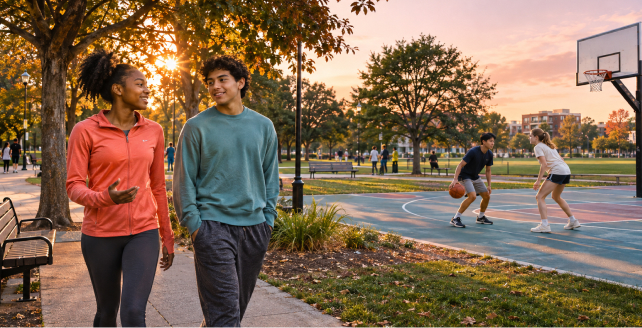
A new report from Crisis Text Line, funded by Nike and released on October 27, 2026, finds that sports, walking, exercise, and outdoor activities are among the coping resources young people mention when discussing emotional distress. The research offers new insight into how physical activity, social connection, and accessible community programs may complement professional mental health support for American teenagers.
The report, titled Sports as a Coping Strategy for Youth in Crisis, draws on de-identified crisis conversations collected between 2022 and 2024. Researchers examined how young people described using sports and movement while navigating anxiety, stress, depression, loneliness, and other difficult experiences.
According to Crisis Text Line’s official research summary, 16% of young people mentioned sports, walking, or time outdoors as a coping resource. Among texters younger than 18, sports ranked as the third most-mentioned coping resource, behind social connection and creative activities. Crisis Text Line
The findings do not establish that exercise treats mental health conditions or prevents crises. Instead, they document what young people reported using for support during difficult moments.
For parents, coaches, educators, and community organizations, the research raises an important question: How can sports and recreational opportunities become part of a broader youth mental health support system without placing unrealistic expectations on physical activity or athletic participation?
Crisis Text Line Releases New Research With Funding From Nike
New York-based nonprofit Crisis Text Line announced the findings on October 27, 2026, through a national research initiative supported by Nike.
Crisis Text Line provides free, confidential crisis support through trained volunteer crisis counselors. Its services also generate de-identified information that researchers can examine to better understand the challenges people describe and the resources they use.
The new study focused specifically on sports, exercise, walking, and outdoor movement.
Rather than asking teenagers to complete a conventional sports participation survey, researchers analyzed existing crisis conversations to identify references to physical activity as a coping resource.
This distinction matters.
The findings describe the experiences of young people who contacted Crisis Text Line. They should not be interpreted as nationally representative estimates of how all American teenagers manage emotional distress.
Tracy Costigan, Ph.D., vice president of Impact Evaluation and Storytelling at Crisis Text Line, explained that volunteer counselors regularly encounter young people who describe movement as something accessible during difficult moments.
In the organization’s October 27 research announcement, Costigan emphasized that running, joining a team, or participating in other activities should not be viewed as replacements for therapy. They may instead offer additional ways for young people to cope, particularly when professional services are difficult to access. globenewswire.com
Nike supported the research as part of its broader work involving youth sports participation and community engagement.
Vanessa Garcia-Brito, Nike’s vice president and chief impact officer, connected the findings to the importance of belonging, positive coaching, and opportunities for young people to participate in sports.
The research therefore addresses more than exercise itself. It also examines the social environments in which movement takes place.
What The 2026 Crisis Text Line Report Found About Youth Coping Strategies
The study identified several patterns in conversations involving young people who mentioned sports or movement.
The most notable finding was that physical activity appeared alongside other forms of support rather than functioning as an isolated coping strategy.
| Research Finding | Reported Result |
|---|---|
| Young people mentioning sports, walking, or outdoor movement as a coping resource | 16% |
| Conversations mentioning sports that also referenced social connection | 27% |
| Conversations mentioning sports that also referenced making art | 25% |
| Anxiety or stress mentioned among under-18 texters who discussed sports | 38.2% |
| Depression mentioned among under-18 texters who discussed sports | 37.3% |
| Isolation or loneliness mentioned among under-18 texters who discussed sports | 23.6% |
Source: Crisis Text Line, Sports as a Coping Strategy for Youth in Crisis, October 2026. Percentages describe different groups of crisis conversations and should not be added together.
The report also identified several commonly mentioned activities: working out or going to the gym, volleyball, basketball, running, and skateboarding.
These activities represent different forms of participation.
Basketball and volleyball may involve teammates, organized schedules, and regular contact with peers. Running and walking may be available independently, while skateboarding can combine movement with informal community relationships.
The findings suggest that young people identify value in multiple forms of physical activity rather than relying exclusively on organized competitive sports.
Importantly, the percentages describing anxiety, depression, and loneliness refer to topics discussed during crisis conversations. They are not clinical diagnoses or estimates of the prevalence of mental health disorders among teenage athletes.
The study also cannot determine whether participation in these activities caused an improvement in emotional well-being.
Its central contribution is documenting how young people themselves describe coping resources during moments of distress.
Sports Ranked Third Among Coping Resources For Teenagers Under 18
One of the report’s most interesting findings concerns the relative frequency with which young people mentioned different coping resources.
Among Crisis Text Line users younger than 18, sports ranked third, behind social connection and making art.
Mental health services appeared below sports in that particular ranking.
This finding requires careful interpretation.
It does not mean that sports are more effective than professional mental health care. Nor does it suggest that young people experiencing serious psychological difficulties should prioritize exercise over clinical evaluation.
The ranking reflects how frequently specific resources were mentioned within the conversations analyzed.
Several factors may influence those mentions.
A teenager may already have access to a basketball court or a walking route but face financial, geographic, scheduling, or other barriers to professional care.
Another young person may find it easier to describe an everyday activity than to discuss formal treatment.
Some teenagers may use sports while also receiving counseling or other mental health services.
The research does not establish that these explanations apply to every participant, but they illustrate why the frequency of a coping resource should not be confused with its clinical effectiveness.
The National Institute of Mental Health’s child and adolescent mental health guidance emphasizes the importance of appropriate professional assessment when young people experience persistent emotional or behavioral difficulties.
Sports participation can be one part of a supportive routine, but it should not delay needed care.
Why Social Connection Matters Alongside Physical Activity
The finding that 27% of sports-related conversations also mentioned social connection is especially relevant to youth sports organizations.
Physical activity can occur in many settings, but organized sports frequently involve relationships with teammates, coaches, volunteers, and other community members.
Those relationships may provide opportunities for encouragement, shared experiences, and a sense of belonging.
A teenager attending basketball practice might benefit from the activity itself while also valuing regular contact with teammates. Another young person may enjoy running with friends because it combines movement with conversation.
The Crisis Text Line findings cannot determine which part of these experiences contributes most to emotional well-being.
Nevertheless, they reinforce the importance of examining the social environment surrounding sports participation.
A team that encourages respectful communication and inclusion may provide a different experience from one characterized by humiliation, bullying, or excessive pressure.
The research should not be interpreted as evidence that all sports environments are psychologically supportive.
Instead, it suggests that community relationships deserve attention when organizations design physical activity opportunities for young people.
In its October 28 research commentary, Crisis Text Line emphasized the role of communities, schools, recreational facilities, and accessible spaces for movement. Crisis Text Line
For youth sports programs, this points toward an important responsibility: providing opportunities for participation while ensuring that athletes know where to find appropriate support beyond their teammates.
Basketball, Volleyball, Running And Skateboarding Offer Different Ways To Participate
The study’s activity findings challenge the assumption that youth sports mental wellness must center exclusively on competitive school teams.
Basketball and volleyball were among the activities young people mentioned, but so were running, gym workouts, and skateboarding.
Each activity offers a different combination of structure, independence, and social participation.
Organized team sports may provide regular schedules and opportunities to build relationships. Individual activities can offer more flexibility for teenagers who prefer exercising alone or who cannot participate in school athletics.
Skateboarding and informal basketball games may also provide opportunities for social interaction outside traditional sports programs.
These differences matter when considering access.
Some teenagers cannot afford organized sports fees, transportation, equipment, or private coaching.
Others may have disabilities, health conditions, or personal circumstances that make particular activities inappropriate or difficult.
Community organizations can respond by offering varied, age-appropriate opportunities rather than assuming one sport will meet every student’s needs.
The CDC’s physical activity guidelines for children recommend that children and adolescents ages 6–17 accumulate at least 60 minutes of moderate-to-vigorous physical activity daily, including appropriate aerobic, muscle-strengthening, and bone-strengthening activities. CDC
These are general public health recommendations, not instructions for managing an individual mental health crisis.
Activity should be appropriate to a young person’s health, abilities, and circumstances. Those with relevant medical concerns or activity restrictions should seek individualized guidance from qualified professionals.
New CDC Data Shows Many American Teenagers Remain Insufficiently Active
The Crisis Text Line findings arrive alongside recent federal research documenting physical activity patterns among American high school students.
The CDC’s 2025 Youth Risk Behavior Survey, summarized in September and October 2026 publications, found that only 25% of U.S. high school students reported being physically active for at least 60 minutes on all seven days of the preceding week.
The same survey found that approximately 58% had played on at least one sports team during the previous 12 months.
These statistics measure different behaviors.
Participating on a sports team does not necessarily mean a student meets daily physical activity recommendations. Conversely, students can be physically active without belonging to an organized team.
The CDC’s 2025 physical activity findings also show that daily physical activity among high school students has declined over the longer period from 2015 to 2025. CDC
The national figures provide useful context for the new Crisis Text Line report.
They indicate that opportunities for regular movement remain an important public health concern, even though the two studies examined different populations and questions.
The CDC survey is designed to assess health-related behaviors among high school students. Crisis Text Line examined conversations from people who contacted a crisis support service.
Their results should not be combined into a single estimate of how sports affect teenage mental health.
However, both sources support the importance of making appropriate physical activity opportunities available to young people.
Rural Communities And Underserved Youth Face Additional Access Challenges
The Crisis Text Line announcement also highlighted the potential relevance of sports and movement for young people who face barriers to conventional mental health services.
These may include teenagers in rural communities, young men who are reluctant to seek support, and families with limited access to local providers.
For some young people, a community recreation center, school gymnasium, or public park may be easier to access than a specialized mental health service.
That does not make recreational activity an equivalent alternative to professional care.
It does suggest that community-based opportunities can play a complementary role in a broader support system.
A rural school might provide supervised after-school recreation while also maintaining clear referral procedures for students needing mental health evaluation.
An urban community organization might offer low-cost basketball or walking programs alongside information about local counseling services.
The practical objective should be to expand options rather than require young people to choose between physical activity and healthcare.
Access also involves more than the presence of a facility.
Transportation, cost, disability accommodations, personal safety, appropriate supervision, and inclusive participation policies can influence whether a young person can use a program consistently.
The new research does not measure the effectiveness of specific community investments, but it identifies an important question for schools and public health organizations: Are young people able to access the coping resources they already describe as useful?
What Coaches, Parents And Schools Can Learn From The Findings
The report offers several practical considerations for adults who support teenagers.
For coaches, the findings reinforce the importance of treating student-athletes as developing young people rather than focusing exclusively on competitive performance.
A supportive sports environment can include respectful communication, appropriate recovery expectations, opportunities for participation, and clear procedures for responding when a student raises a concern.
Coaches should understand that their responsibilities have limits.
They can listen, offer appropriate support, and connect athletes with qualified professionals, but they should not attempt to diagnose mental health conditions or provide clinical treatment.
Parents and caregivers can use the research to recognize that movement may be one of several activities young people find helpful during stressful periods.
A walk, recreational game, or other enjoyable activity can provide an opportunity for connection, but it should not be imposed as a solution to serious emotional distress.
Schools can consider how physical education, after-school sports, recreation, and mental health services work together.
This may involve ensuring that students have opportunities to participate in activities without unnecessary financial or social barriers, while maintaining access to school counselors and community healthcare providers.
The CDC notes that regular physical activity is associated with several benefits for school-aged children, including improved attention, memory, and a reduced risk of depression. Its March 2026 overview of children’s physical activity benefits summarizes these findings. CDC
Those broader health benefits support promoting age-appropriate physical activity, but they do not prove that any particular sport or recreational program can treat an individual mental health condition.
Why Sports Cannot Replace Professional Mental Health Care
The distinction between coping resources and clinical treatment is central to interpreting the Crisis Text Line research responsibly.
Young people may use movement to manage difficult emotions, maintain routines, or connect with other people.
However, serious or persistent psychological difficulties may require professional evaluation and treatment.
The new study did not randomly assign teenagers to sports programs, compare different treatments, or measure whether physical activity prevented mental health crises.
It also relied on conversations from individuals who contacted a crisis support service, meaning its findings cannot automatically be generalized to all American adolescents.
The research therefore supports a narrower conclusion: sports and movement were meaningful coping resources mentioned by a portion of young people experiencing distress.
Families and educators should avoid interpreting the report as evidence that more exercise will necessarily resolve depression, anxiety, or other mental health concerns.
When a young person’s emotional or behavioral changes are persistent, worsening, or interfering with daily functioning, consultation with a qualified mental health professional is appropriate.
Immediate safety concerns require urgent attention.
In the United States, the 988 Suicide & Crisis Lifeline provides crisis support, while Crisis Text Line offers confidential text-based support by texting HOME to 741741. These services can help people access support, but immediate life-threatening emergencies require emergency services.
The Research Highlights A Broader Role For Community Sports Programs
The October 2026 Crisis Text Line report provides a timely perspective on youth mental wellness by examining coping strategies described in young people’s own conversations.
Its findings show that sports, walking, and outdoor movement appear alongside relationships, creative activities, and other forms of support.
The report also illustrates why physical activity should be considered within a wider network of resources rather than presented as a stand-alone mental health intervention.
For organizations working with student-athletes, the practical implications extend beyond increasing participation numbers.
Programs should consider whether young people feel welcome, whether coaches understand appropriate support boundaries, and whether students can access professional assistance when necessary.
For community leaders, the findings raise questions about affordable recreation, safe public spaces, and the availability of inclusive activities for teenagers with different interests and abilities.
Future research could examine whether specific program designs improve access to support, strengthen social connection, or produce measurable changes in well-being.
Until those outcomes are established, the most defensible message is that sports and movement can be valuable components of a supportive environment, but they are not substitutes for evidence-based mental health care.
By documenting the coping resources young people already mention, Crisis Text Line’s research offers schools, families, coaches, and community organizations a clearer starting point for understanding how physical activity and emotional support can coexist.