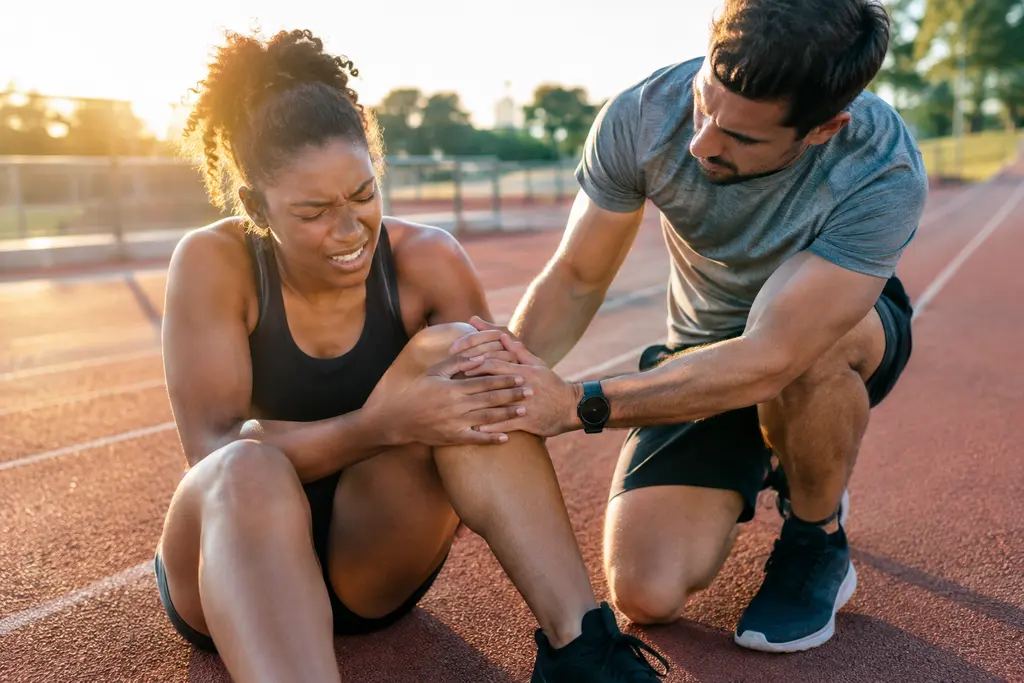
Sports culture often celebrates athletes who keep going.
They play through pain. They finish the race. They stay in the lineup. They tell themselves they can deal with the injury later.
That image of toughness can become dangerous when persistence starts replacing medical evaluation.
A recent dispute involving three-time Olympian Lolo Jones has brought that problem back into public view. In July 2026, Jones publicly accused USA Bobsled/Skeleton and the U.S. Olympic & Paralympic Committee of failing to provide adequate medical support after she says she suffered a serious back injury while training before the 2025 World Championships in Lake Placid, New York. Jones has said she experienced severe back pain, numbness, leg instability, foot drop, and loss of bladder control before eventually obtaining imaging and surgery on her own. (Us Weekly report on Lolo Jones)
Those allegations are serious, but they remain part of an ongoing dispute and should not be treated as independently established proof of every claim Jones has made.
The broader lesson does not require deciding that dispute.
Athletes should not have to prove resilience by ignoring potentially serious symptoms, hiding pain, or competing without access to appropriate healthcare.
Real resilience includes knowing when performance is no longer the most important problem in the room.
What Lolo Jones Says Happened
Jones is one of the rare U.S. athletes to compete at both the Summer and Winter Olympics.
The 43-year-old represented the United States in track and field at the 2008 Beijing Olympics and 2012 London Olympics, then competed in bobsled at the 2014 Sochi Winter Olympics. USA Bobsled/Skeleton lists her as a world champion and longtime national-team athlete. (Lolo Jones athlete profile)
According to Jones and recent reporting, her current medical dispute traces back to training before the 2025 IBSF World Championships in Lake Placid, New York.
Jones says she was testing a new sled and racing position when she suffered severe lower-back symptoms. She has alleged that those symptoms later included numbness, instability in her legs, foot drop, and loss of bladder control. She has also said she did not receive imaging at that stage and ultimately competed at the World Championships, where the U.S. team finished sixth. (Us Weekly report)
Jones says that after returning home she paid for her own MRI and learned that she had significant spinal injuries. Her subsequent public claims have focused not only on the injury itself but on what she describes as failures of medical access, rehabilitation support, and athlete protection.
Some parts of the larger dispute are documented beyond Jones’ social-media statements.
Southern California News Group reporting published before her July 2026 public comments said the USOPC had acknowledged that Jones was wrongly denied approved medical treatment on February 28, 2025, an incident that contributed to a later verbal confrontation and restrictions on her use of training-center facilities. A July 2026 USOPC communication later allowed renewed access to housing, sports medicine, training, and related services at a high-performance camp if requested by USA Bobsled/Skeleton. (Orange County Register report)
That acknowledgment does not automatically validate every allegation Jones has made about her injury, diagnosis, treatment, or organizational responsibility.
It does make the underlying question difficult to dismiss:
What should happen when an athlete reports symptoms that may require urgent medical attention?
Serious Symptoms Are Not A Test Of Mental Toughness
Athletes routinely experience soreness, stiffness, fatigue, and discomfort.
That reality can make it difficult to determine when something deserves immediate evaluation.
The answer should not depend on whether the athlete is considered tough enough to continue.
Certain neurological symptoms following a back or neck injury warrant urgent professional attention. MedlinePlus states that spinal injuries can involve weakness, numbness, difficulty walking, and loss of bladder or bowel control and describes spinal cord injury as a medical emergency requiring prompt assessment. (MedlinePlus spinal cord trauma guidance)
Mayo Clinic similarly advises emergency medical attention when back problems are associated with worsening weakness or numbness, or new bowel or bladder dysfunction.
This does not mean every episode of back pain is a spinal emergency.

It means athletes, coaches, teammates, and parents should not try to decide that potentially serious neurological symptoms are “just pain” or something to push through.
Medical evaluation belongs with qualified healthcare professionals.
The Athlete Should Not Have To Earn Medical Attention
One of the more damaging messages in competitive sports is that healthcare becomes justified only after an athlete can no longer perform.
The standard should be different.
An athlete should be able to report a concerning symptom without first proving that it is severe enough to stop them.
That distinction matters because performance can hide medical problems.
An elite athlete may still be able to sprint, lift, skate, throw, or compete despite an injury. Adrenaline, competitive motivation, pain tolerance, and fear of losing an opportunity may all influence what the athlete is willing to endure.
Being physically capable of continuing does not determine whether continuing is medically appropriate.
The U.S. Olympic & Paralympic Committee describes its sports-medicine model as athlete-centered and multidisciplinary, involving physicians, physical therapists, athletic trainers, chiropractors, massage therapists, and other specialists. Its sports medicine program operates clinics in Colorado Springs, Colorado; Lake Placid, New York; and Chula Vista, California and states that evaluation and management should be individualized to the athlete and sport.
That kind of system exists for a reason.
Elite sport places unusual demands on the body. Medical decision-making should therefore become more structured—not less important because the athlete is exceptionally fit.
Independent Medical Decisions Protect Athletes
College sports provide another useful model.
The NCAA’s current Independent Medical Care Best Practices require an administrative structure in which primary athletics healthcare providers have what the NCAA calls “unchallengeable autonomous authority” over diagnosis, management, and return-to-play decisions.
The language is intentionally strong.
A coach may want an athlete available.
A team may face an important championship.
The athlete may desperately want to compete.
None of those interests should override the clinical judgment of the healthcare professionals responsible for the athlete.
This protects athletes not only from pressure imposed by others but also from their own understandable desire to return.
Competitive athletes are often trained to tolerate discomfort and prioritize team goals. Those qualities can be useful in sport. They can also make it harder to stop when stopping is medically appropriate.
Independent medical authority creates a boundary that motivation alone cannot erase.
Self-Advocacy Is A Resilience Skill
Athletes are often taught to be coachable.
Listen to instructions. Trust the program. Do the work.
Those are useful qualities until they are interpreted to mean that the athlete should never question what is happening to their body.
Self-advocacy can look different:
“I need someone to evaluate this.”
“This symptom is getting worse.”
“This does not feel like normal soreness.”
“I do not understand why I am being asked to continue.”
“I would like another medical opinion.”
“I want to know what the return criteria are before I practice again.”
An athlete does not need medical expertise to ask those questions.
They need enough psychological safety to say them.

The USOPC currently maintains Athlete Healthcare Navigators to help eligible Team USA athletes identify medical resources, insurance options, specialist networks, and assistance programs. Its Medical Network connects athletes with providers in orthopedics, sports medicine, general medicine, women’s health, and other specialties. (USOPC Athlete Healthcare)
That structure recognizes something important: navigating healthcare can be difficult even for elite athletes.
Seeking help with the system is not evidence of weakness.
“Push Through It” Has Limits
There is nothing inherently wrong with competing through ordinary discomfort.
Sports involve exertion. Muscles become sore. Athletes get tired. Minor aches happen.
But “push through it” becomes unsafe when it turns into a universal response.
The phrase does not distinguish between normal training discomfort and symptoms that may indicate significant injury.
It does not distinguish between an athlete who has been medically assessed and one who has not.
And it can discourage the athlete from reporting changes because acknowledging them begins to feel like a character flaw.
A safer sports culture replaces the automatic instruction with better questions:
What changed?
When did it start?
Is it getting worse?
Has a qualified clinician evaluated it?
What restrictions or recommendations were given?
Does the athlete know whom to contact if symptoms change?
Those are not diagnostic questions for coaches.
They are questions about whether the athlete is connected to appropriate care.
Mental Health Can Affect Whether Athletes Speak Up
Medical support is also a mental-health issue.
Athletes may hide symptoms because they fear losing playing time, scholarships, contracts, team selection, or status.
Others worry about being labeled fragile.
Some have learned that the admired athlete is the person who never needs anything.
That is why supportive environments matter.
The NCAA’s current Mental Health Best Practices emphasize healthy athletic environments, clear pathways to qualified mental-health providers, and a culture in which student-athletes can seek help. The NCAA also specifically states that coaches and nonclinical personnel should help recognize concerns without attempting to diagnose athletes.
Physical and mental-health culture cannot be separated completely.
An athlete who believes vulnerability threatens their place on the team may conceal both emotional distress and physical symptoms.
A culture that supports honest reporting protects both.
What Coaches Can Do Without Practicing Medicine
Coaches do not need to diagnose injuries to make their teams safer.
They can establish expectations before problems happen.
Athletes can be told clearly that reporting symptoms will not automatically be interpreted as poor commitment.
Coaches can avoid rewarding athletes specifically for hiding injuries or ignoring medical restrictions.
They can make clear that the medical team—not the coaching staff—controls clinical decisions.
They can also maintain communication when athletes are sidelined so that injury does not become social exclusion.
CPCWA’s guide to coping with depression after a sports injury examines why being removed from normal sport participation can affect identity, mood, routine, and social connection.
A supportive coach therefore has two distinct responsibilities:
Respect the healthcare boundary.
Keep treating the injured athlete like a valued person and team member.
Parents And Young Athletes Need The Same Boundary
The pressure to continue is not limited to elite sports.
Youth athletes may feel pressure because a tournament is approaching, the family has spent money on travel, scouts are watching, or another player could take their position.
Parents can unintentionally reinforce this pressure with apparently harmless questions:
“Can you just get through this weekend?”
“Are you sure it really hurts that much?”
“You’ve trained all year for this.”
A safer response focuses on information rather than stakes.
“What did the athletic trainer or doctor say?”
“Has anything changed since you were evaluated?”
“Do we need to contact the medical team again?”
“The tournament matters, but your health matters beyond this weekend.”
If there is a concerning injury or a new neurological symptom, families should seek appropriate medical care rather than using an article, coach, teammate, or internet discussion to determine whether participation is safe.
Second Opinions Are Not Betrayal
Athletes sometimes worry that seeking another opinion implies distrust.
It does not have to.
Medicine contains uncertainty. Injuries evolve. Symptoms change. Different specialists bring different expertise.
A second opinion may be particularly reasonable when symptoms are severe, unexplained, worsening, or inconsistent with the current rehabilitation plan.
That does not mean athletes should repeatedly seek opinions until someone tells them what they want to hear.
It means they can ask appropriate questions when they remain concerned.
The USOPC’s nationwide Medical Network is specifically designed to connect eligible Team USA athletes with specialty care beyond one training-center clinician.
Access to additional expertise is part of good healthcare, not a challenge to resilience.
What Lolo Jones’ Story Should And Should Not Teach Us
Jones’ experience is still being publicly disputed and reviewed through multiple organizational and reporting channels.
It should not be used to claim that every athlete in U.S. Olympic sport receives inadequate care.
The USOPC currently describes extensive healthcare resources for eligible athletes, including sports medicine clinics, specialist networks, insurance programs, medical assistance, mental-health services, and athlete healthcare navigation.
It would also be irresponsible to diagnose Jones retrospectively from news reporting or decide exactly what treatment should have occurred without access to her medical records.
What her story can do is expose a broader vulnerability in sport:
Athletes sometimes believe that perseverance is more valuable than escalation.
When pain becomes severe, symptoms become neurological, or functioning changes unexpectedly, that belief can be dangerous.
The right response is not to prove that the athlete can tolerate more.
It is to get appropriate medical attention.
Adequate Medical Support Is Part Of Performance
Healthcare is sometimes treated as something that interrupts training.
A better model treats it as part of training.
The athlete who reports a problem early may protect a season.
The athlete who follows a rehabilitation restriction may protect a career.
The athlete who requests another evaluation may identify something that requires different management.
The athlete who receives mental-health support during a long recovery may remain more connected to sport and daily life.
None of those outcomes is guaranteed.
But access to appropriate care gives athletes better information for making decisions.
That is what resilience requires: accurate information, realistic adaptation, support, and the ability to change course when circumstances demand it.

Resilience Is Not Silence
Sports will always contain discomfort.
They will always require persistence.
And athletes will sometimes choose to compete through difficult circumstances after appropriate medical evaluation and informed discussion with their care team.
That is different from competing because speaking up feels unacceptable.
A resilient athlete does not need to ignore their body.
They do not need to hide serious symptoms.
They do not need to earn the right to see a clinician by reaching the point where they can no longer perform.
Lolo Jones’ allegations are specific to her experience and remain part of an ongoing dispute. The broader safety principle is much simpler.
Medical symptoms deserve medical attention.
The athlete’s job is not to prove how much they can endure before asking for it.