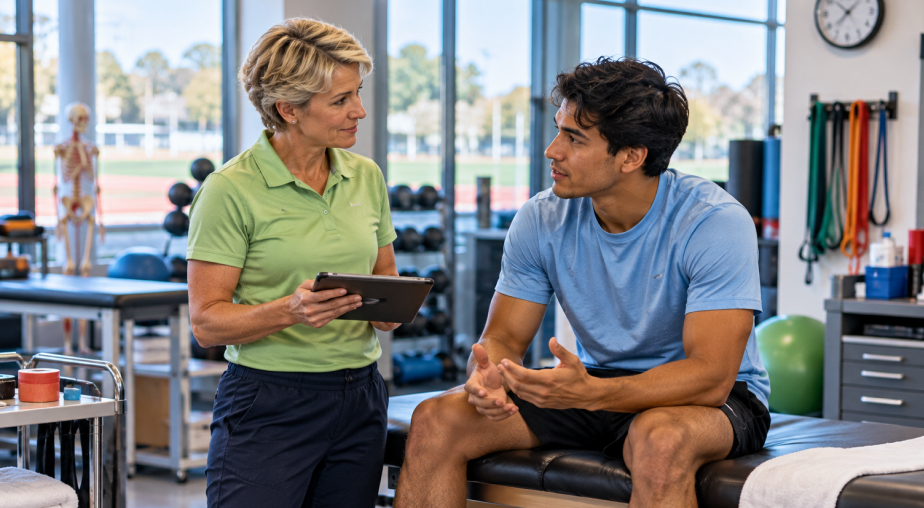
A sports injury can change far more than an athlete’s ability to practice or compete. It may interrupt friendships, disrupt academic and athletic routines, create uncertainty about recruitment opportunities and affect the sense of identity that develops through years of participation.
At the University of Findlay in Findlay, Ohio, student-athletes and athletic staff are bringing greater attention to those psychological challenges.
An October 9, 2026, report by student journalist Emily Gillson, published by the university’s student news outlet The Pulse, examined how injuries affect college athletes beyond their physical recovery.
The report featured Jam Thigpen, a University of Findlay women’s basketball player who experienced a serious knee injury during high school, alongside perspectives from Fiona Hanks, the university’s assistant athletic director for sports medicine, and Brianna Sims, head women’s basketball coach.
Their experiences raise an important question for college athletics: Are injured student-athletes receiving enough emotional support while they navigate rehabilitation, changes in team participation and uncertainty about their competitive futures?
The issue extends beyond one Ohio university.
Research published in Sports Medicine and guidance from the NCAA recognize that psychological well-being can influence how athletes experience injury rehabilitation and return-to-sport decisions.
However, experiencing frustration, sadness or anxiety after an injury does not automatically mean an athlete has a mental-health disorder. Emotional responses vary, and persistent or significant concerns require assessment by appropriately qualified professionals.
Findlay’s story offers an opportunity to examine what supportive athletic environments can provide, where professional mental-health services become important and why recovery should not be measured only by the date an athlete returns to competition.
University Of Findlay Athletes Describe The Mental Toll Of Injuries
The October 9 report, titled An Unspoken Toll: Athletic Injuries and Mental Health, examined how injuries can affect college athletes socially and emotionally.
The University of Findlay student-athlete injury report included interviews with individuals who encounter these challenges from different perspectives.
Thigpen described her personal experience recovering from an anterior cruciate ligament injury.
Hanks discussed the psychological changes she has observed throughout her career in athletic training and sports medicine.
Sims explained how she approaches communication and team support when players are injured.
Together, their comments highlighted an issue that can receive less attention than the physical injury itself.
Athletic departments have established processes for evaluating injuries, organizing rehabilitation and determining whether players can safely resume activity.
The emotional consequences are sometimes less visible.
An athlete may continue attending classes and medical appointments while feeling disconnected from teammates.
Another may worry about losing a starting position, scholarship opportunities or the ability to compete at a previous level.
Some athletes adjust relatively comfortably to temporary changes in participation.
Others experience persistent distress that warrants professional attention.
The difference cannot be determined simply by looking at an injury’s severity or expected recovery time.
For universities, the challenge is recognizing these individual experiences without treating every injured athlete as a mental-health patient.
Jam Thigpen’s ACL Injury Interrupted Her Basketball Recruitment
One of the most personal accounts in the Findlay report came from Jam Thigpen, a junior guard on the university’s women’s basketball team.
Thigpen, who is from Flint, Michigan, previously attended Carman-Ainsworth High School and Siena Heights University.
According to the university’s 2026–27 women’s basketball roster, she wears No. 20 for the Oilers.
Her experience with injury began before her arrival at Findlay.
During her senior year of high school, Thigpen tore her ACL, an important ligament that helps stabilize the knee.
The injury affected her ability to participate in basketball at a particularly consequential stage of her athletic development.
High school seniors pursuing college athletics may be managing recruitment conversations, scholarship expectations, school commitments and competitive opportunities.
For Thigpen, the injury disrupted that process.
In the October report, she described the experience as a substantial burden that affected her physically and emotionally.
She also identified missed college recruitment opportunities as a financial concern.
Her account illustrates why sports injuries cannot always be understood as isolated medical events.
A physical injury may coincide with decisions about education, athletics and future opportunities.
However, the reporting does not establish the exact financial value of the recruitment opportunities Thigpen missed, and it would be inappropriate to invent an estimate.
It also does not establish that she developed a specific mental-health disorder.
What her experience demonstrates is that the consequences of injury can extend into several parts of a young athlete’s life at once
Fiona Hanks Identifies Isolation As A Major Concern
Fiona Hanks, the University of Findlay’s assistant athletic director for sports medicine, brought a different perspective to the discussion.
According to The Pulse, Hanks has spent approximately 27 years at Findlay, working in roles that have included athletic trainer and head athletic trainer.
That experience has given her opportunities to observe how athletes respond when injuries interrupt their normal participation.
One concern she identified was the feeling of being left out.
For college athletes, team membership often provides a daily social structure.
Practices, training sessions, team meetings and competitions create regular opportunities for interaction.
When an injury prevents someone from participating, those routines may change abruptly.
The athlete may spend more time in rehabilitation appointments and less time participating in ordinary team activities.
Even when teammates remain supportive, the injured player may feel separated from experiences that previously helped define their college life.
Hanks also described observing athletes experience periods of anxiety and depression-related difficulties after injuries.
Her comments are observations from professional experience, not a clinical assessment of every injured athlete at Findlay.
The distinction is important because social isolation and emotional distress are not inevitable consequences of injury.
Nevertheless, the concern is supported by broader research.
A 2024 sports injury psychology consensus statement published in Sports Medicine examined psychological factors involved in injury risk, rehabilitation and returning to sport.
The researchers identified social support, emotional responses and an athlete’s sense of connection as relevant considerations throughout recovery.
For coaches and athletic staff, the practical implication is that an injured athlete should not automatically disappear from the team’s social environment.
Brianna Sims Emphasizes Communication With Injured Players
University of Findlay women’s basketball coach Brianna Sims also addressed the importance of maintaining relationships during injury recovery.
In the October report, Sims said she regularly checks in with players and encourages teammates to remain attentive to one another.
She described a roster of 22 players at the time of her interview and emphasized the responsibility teammates have to support someone who is injured.
The number reflects Sims’ statement in the report rather than a separate count of the university’s published roster.
Her approach recognizes that coaches influence more than playing time and competitive performance.
Coaches help establish expectations about how athletes communicate, how teammates respond to setbacks and whether injured players continue to feel included.
That influence can become particularly important when an athlete is unable to contribute in the same way as before.
A player recovering from an injury may no longer participate in full practices or games.
However, the athlete can still be a valued member of the team.
Depending on medical restrictions and personal preferences, participation might involve attending team meetings, watching practice, contributing to discussions or maintaining informal contact with teammates.
These opportunities should be appropriate for the athlete’s circumstances.
An injured player should not feel pressured to attend every activity or take on additional responsibilities simply to demonstrate commitment.
Supportive coaching also requires recognizing professional boundaries.
A coach can listen, maintain contact and help a player identify available resources.
Clinical mental-health evaluation and treatment belong with qualified healthcare professionals.
Why Athletic Identity Can Change After A Serious Injury
For many college athletes, sport is closely connected to personal identity.
An athlete may have spent years developing skills, pursuing competitive goals and building relationships through a particular team or sport.
Those experiences can influence how the individual understands personal achievement and belonging.
A serious injury can interrupt that structure.
The athlete may temporarily lose opportunities to compete, contribute to team results or demonstrate progress through familiar performance measures.
For someone whose identity is strongly connected to athletics, the change may feel particularly significant.
Researchers studying the psychology of sports injuries have identified concerns involving confidence, autonomy, social connection and future participation.
The 2024 Sports Medicine consensus statement, authored by researchers including Ulrika Tranaeus, Adam Gledhill, Leslie Podlog and Andreas Ivarsson, examined five decades of scholarship on psychological responses to sports injuries.
Its findings emphasize that rehabilitation involves cognitive, emotional and behavioral processes alongside physical recovery.
The research on psychological responses to sports injuries also discusses how athletes may experience uncertainty about their ability to return to previous levels of competition.
However, athletic identity is not inherently harmful.
Strong connections to sport can provide motivation, friendship and a sense of purpose.
The concern arises when an injury disrupts those experiences and an athlete has difficulty finding other sources of connection or meaning.
For college students, academic interests, friendships outside athletics, family relationships and future career goals may remain important during recovery.
Maintaining those connections does not require abandoning competitive ambitions.
It can simply provide additional sources of support while participation is temporarily limited.
ACL Injuries Can Create Uncertainty About Returning To Basketball
Thigpen’s experience also raises questions about the psychological challenges associated with ACL injuries.
The anterior cruciate ligament plays an important role in knee stability, particularly during movements involving changes of direction, cutting and landing.
Basketball frequently requires those movements.
When an athlete experiences an ACL injury, medical treatment and rehabilitation depend on the individual’s condition, clinical assessment and other relevant factors.
The recovery process may involve uncertainty about future participation.
An athlete can be concerned about whether the knee will tolerate demanding movements or whether returning to competition might lead to another injury.
Those concerns should not automatically be interpreted as a lack of determination.
In August 2026, the International Olympic Committee published an updated consensus statement examining mental health in elite athletes.
The document identifies psychological responses to injury as an important consideration during rehabilitation.
It discusses concerns such as fear of reinjury, reduced confidence and changes in athletic identity.
The 2026 IOC mental-health consensus statement also recognizes that physical and psychological readiness do not always progress at the same pace.
The statement primarily addresses elite athletes, so its findings should not be treated as a direct clinical evaluation of Thigpen or other individual college players.
Nevertheless, it provides useful context for understanding why return-to-sport decisions should consider more than elapsed recovery time.
Medical clearance, functional capacity, sport-specific demands and psychological readiness may all be relevant.
Those assessments should be coordinated by appropriately qualified healthcare professionals.
Physical Recovery And Psychological Readiness Are Different Considerations
Sports culture often celebrates the moment an injured athlete returns to competition.
The comeback may represent months of rehabilitation, commitment and personal effort.
However, returning to play is not always a single event.
An athlete might first resume selected training activities, then progress toward more demanding movements before participating fully in competition.
Even after returning, the athlete may need time to rebuild confidence and adjust to the demands of the sport.
A review published online on October 5, 2026, in Operative Techniques in Sports Medicine examined this issue.
Researchers James L. W. Houle and Justin T. Worley reviewed mental-health considerations associated with sports injuries and psychological readiness to return to play.
Their article emphasized the value of interdisciplinary decision-making and integrating appropriately qualified mental-health professionals when needed.
The 2026 review of psychological readiness after sports injury also considered how emotional responses can influence the experience of rehabilitation.
These findings support a broader understanding of recovery.
An athlete may meet certain physical milestones while remaining apprehensive about specific movements.
Another athlete may feel confident but still require medical restrictions because the injured area has not recovered sufficiently.
Neither confidence nor fear should independently determine whether participation is medically appropriate.
CPCWA has previously examined this distinction in its guide explaining why injury resilience is not about returning as fast as possible.
The central principle is that recovery should be guided by individual medical needs, appropriate progression and communication rather than pressure to meet an arbitrary return date.
NCAA Mental Health Best Practices Establish Support Expectations
The Findlay report also examined the responsibilities NCAA member institutions have regarding student-athlete mental health.
The NCAA released the second edition of its Mental Health Best Practices in early 2024.
The updated framework became effective on August 1, 2024.
According to the NCAA, member institutions must make mental-health services and resources available to student-athletes in a manner consistent with those best practices.
The framework emphasizes healthy athletic environments, identification and screening procedures, written mental-health action plans and access to qualified providers.
The NCAA Mental Health Best Practices also recommend that schools establish clear procedures for routine and emergency mental-health concerns.
An important distinction concerns staffing.
The NCAA does not require every athletic department to employ a dedicated licensed sports psychologist.
Schools may organize access to qualified mental-health professionals through different institutional arrangements.
That difference is especially relevant to smaller colleges and universities, where athletic departments may not have the same staffing structure as larger institutions.
The requirement to provide appropriate mental-health services should not be confused with a requirement to maintain one specific professional position.
For injured athletes, the practical question is whether they understand how to access suitable services when they need them.
Clear referral procedures, confidential communication and coordination between athletic and healthcare personnel can help address that concern.
Findlay Does Not Have A Dedicated Sports Psychologist In Its Athletic Department
One of the notable details in the October 9 report was the discussion of professional mental-health staffing at Findlay.
Hanks stated that the university did not employ a dedicated licensed sports psychologist within its athletic department at the time of reporting.
She also expressed interest in having that type of professional available.
However, the absence of an athletics-specific sports psychologist does not mean Findlay students have no access to mental-health care.
The university’s official athletics website identifies counseling, consultation, crisis intervention and referral services among the resources available to student-athletes.
Its student-athlete mental-health resources specifically mention concerns related to injuries, stress, relationships, anxiety and depression.
Findlay also maintains campus counseling services through the Bucher Center.
The university’s Counseling Services staff directory identifies professional counseling personnel and provides contact information.
In addition, the university’s Cosiano Health Center offers general healthcare services and information about virtual medical and behavioral-health support.
These resources demonstrate that students have several potential points of contact.
They do not establish how frequently injured athletes use those services, whether every student can obtain an appointment immediately or whether existing staffing meets all demand.
Those questions would require additional institutional data.
The distinction matters for accurate reporting.
Findlay’s staffing arrangement raises legitimate questions about specialized access and coordination, but it should not be described as a complete absence of mental-health support.
Confidentiality Matters When Athletes Seek Professional Care
Access to professional services is only one part of supporting student-athlete mental health.
Confidentiality can also influence whether an athlete feels comfortable seeking assistance.
College athletes may worry that discussing psychological concerns could affect playing time, relationships with coaches or perceptions of their reliability.
Those concerns should be addressed through accurate information about available services and their privacy procedures.
Mental-health professionals have obligations regarding confidentiality, although specific rules and exceptions depend on applicable law, professional standards and the circumstances of care.
Athletes should be able to ask providers how information is handled before sharing sensitive details.
They may also want to understand when information could be disclosed for safety reasons or under other legally recognized circumstances.
A coach should not assume that an athlete seeking counseling has agreed to share personal medical information with the team.
Likewise, a student should not be expected to describe private treatment decisions to teammates.
Athletic trainers and coaches can help athletes locate appropriate services while respecting those boundaries.
This approach supports a distinction between team communication and clinical care.
The team may need to understand participation restrictions relevant to safety.
That does not necessarily mean it needs access to an athlete’s diagnosis, counseling discussions or other private mental-health information.
Injury Recovery Can Affect Academic And Financial Expectations
Thigpen’s experience also highlights the relationship between injury and educational opportunity.
For high school athletes pursuing college sports, recruitment can be an important part of planning for the future.
Injury may interrupt competition during a period when coaches are evaluating prospective players.
It can also create uncertainty about scholarship opportunities, athletic development and future team placement.
However, the consequences vary considerably.
Recruitment decisions depend on many factors, including athletic performance, academic eligibility, institutional priorities and scholarship availability.
An injury does not automatically eliminate an athlete’s college opportunities.
Similarly, an injured college student may have questions about athletic participation, scholarship conditions or eligibility rules.
Those questions should be directed to appropriate university officials rather than answered through assumptions about NCAA policy.
Academic responsibilities may also continue during rehabilitation.
A student managing medical appointments, reduced mobility or changing schedules may need additional coordination with instructors and campus support services.
The psychological impact can involve uncertainty about several responsibilities at once.
For athletic departments, this suggests that injury support should not be limited to treatment appointments.
Athletes may also benefit from knowing which university offices can answer academic, financial-aid and eligibility questions.
Providing accurate information can reduce unnecessary confusion, although it cannot guarantee that every concern will be resolved.
Teammates Can Help Injured Athletes Maintain A Sense Of Belonging
The University of Findlay interviews repeatedly returned to the importance of relationships.
Hanks identified isolation as a concern.
Sims emphasized communication.
Thigpen described the value of coaches who are willing to listen.
These perspectives point toward an important feature of athlete well-being: maintaining meaningful connections while physical participation is restricted.
An injured athlete may still value being invited to team activities, receiving updates from teammates or participating in appropriate discussions.
Small gestures can communicate that the person’s place within the group does not depend entirely on immediate athletic performance.
However, support should reflect the athlete’s preferences.
Some individuals may appreciate regular contact.
Others may need more privacy or flexibility while managing rehabilitation, schoolwork and personal responsibilities.
A supportive team environment should allow room for those differences.
The 2024 Sports Medicine consensus statement identified social support as a relevant factor in the psychological experience of injury rehabilitation.
It also emphasized the importance of athletes having a sense of autonomy during recovery.
That suggests a useful balance.
Teams can offer connection without forcing participation.
Coaches can communicate concern without demanding personal disclosures.
Athletes can remain valued members of their teams while following medical restrictions.
These practices may support a healthier environment, but they should not be presented as substitutes for professional mental-health treatment.
Coaches And Athletic Trainers Have Different Responsibilities
The Findlay story also demonstrates why responsibilities should remain clearly defined.
Coaches oversee athletic preparation, team participation and competitive decisions within their professional roles.
Athletic trainers and sports medicine professionals assess and manage injuries according to their qualifications and clinical responsibilities.
Licensed mental-health professionals provide assessment and treatment when psychological concerns require clinical care.
Those roles can complement one another.
For example, a coach may notice that an injured athlete has stopped communicating with teammates.
An athletic trainer may recognize that the athlete is expressing persistent concern about rehabilitation.
A qualified mental-health professional can evaluate whether additional psychological care is appropriate.
Coordination can help athletes receive relevant support without requiring one person to perform every function.
The NCAA’s updated framework emphasizes collaboration and appropriate referral procedures.
It also recognizes that coaches and other non-clinical staff can contribute to supportive environments without diagnosing mental-health conditions.
For athletes, knowing whom to contact for different concerns can make the system easier to navigate.
For institutions, clear communication among qualified personnel may help reduce confusion about responsibilities.
When An Injured Athlete Should Consider Professional Mental Health Support
Emotional reactions after an injury are not always signs of a clinical condition.
Disappointment about missing competition, frustration with physical limitations and uncertainty about recovery can be understandable responses to a difficult experience.
However, some concerns may become persistent or interfere substantially with daily functioning.
The National Institute of Mental Health identifies changes in sleep, concentration, mood, appetite, motivation and the ability to complete everyday responsibilities as possible reasons to seek professional guidance.
Its guidance on when to seek mental-health help encourages people to consider both the duration and severity of their symptoms.
For injured athletes, significant changes affecting schoolwork, relationships, rehabilitation participation or ordinary activities may warrant discussion with a qualified healthcare professional.
The same applies when distress is worsening rather than improving.
An athlete should not assume that psychological concerns must be managed alone.
They also should not use another player’s recovery story to determine whether they need treatment.
Professional evaluation can help establish what type of support, if any, is appropriate for the individual’s circumstances.
Physical rehabilitation, return-to-play clearance and mental-health treatment decisions should remain with qualified professionals.
In the United States, people experiencing a mental-health crisis can contact the 988 Suicide & Crisis Lifeline by phone, text or online chat. Immediate danger requires emergency assistance.
Findlay’s Injury Conversations Highlight A Wider Responsibility In College Sports
The University of Findlay report illustrates why athlete mental health deserves attention throughout the injury-recovery process.
Jam Thigpen’s high school ACL injury affected more than her ability to play basketball. Her experience also involved emotional strain and disrupted recruitment opportunities.
Fiona Hanks’ observations highlighted how injured athletes may become disconnected from familiar team routines.
Brianna Sims’ comments emphasized the value of maintaining communication and treating injured players as continuing members of the team.
Together, their perspectives show that recovery can involve physical, psychological, social and educational concerns.
The broader research supports taking those dimensions seriously, but it does not establish that every injured athlete will experience a mental-health disorder.
Nor does the October 9 report provide evidence that Findlay’s existing services have produced particular clinical outcomes.
Its contribution is to make the experiences and institutional questions more visible.
For colleges, the challenge is ensuring that injured athletes understand their available resources, receive appropriate medical guidance and have access to qualified mental-health professionals when needed.
For coaches, the responsibility includes maintaining respectful relationships without crossing into clinical decision-making.
For teammates, it may mean continuing to recognize an injured player’s place within the group.
And for athletes, it means understanding that temporary changes in performance or participation do not determine their personal worth.
A successful recovery should not be defined exclusively by the first game back. It should also respect the athlete’s health, individual circumstances and ability to make informed decisions about what comes next.