
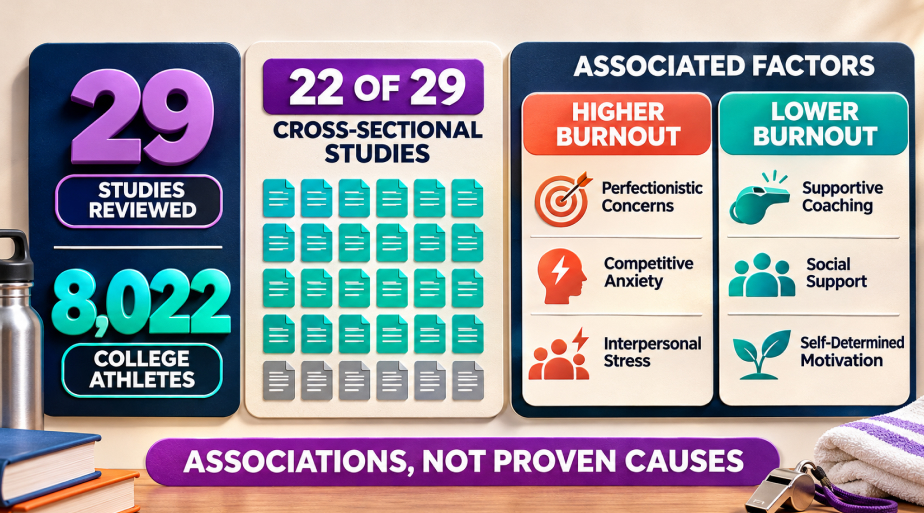
New research highlighted by California State University, Fullerton, on October 28, 2026, is drawing attention to the psychological pressures experienced by college athletes. After reviewing 29 studies involving 8,022 student-athletes, researchers identified several factors associated with higher or lower levels of athlete burnout, including perfectionism, competitive anxiety, coaching relationships, social support, and motivation.
The research, titled A Scoping Review of Intercollegiate Athlete Burnout, was published in the peer-reviewed Journal of Intercollegiate Sport on May 12, 2026. Cal State Fullerton brought renewed attention to the findings in its October 28 university news report.
The study was led by Dr. Katrina J. Waldhauser, assistant professor of kinesiology at California State University, Fullerton, in collaboration with Selina Chen, Stefanie Atkinson, and Desmond McEwan of the University of British Columbia.
Their findings suggest that college athlete burnout cannot be explained by training demands alone. Psychological experiences, interpersonal relationships, and the broader environment surrounding collegiate sports may also be important.
However, the researchers emphasized a significant limitation: most studies examined associations at a single point in time. The evidence therefore cannot establish whether particular factors cause burnout or whether burnout itself influences those factors.
For student-athletes, coaches, families, and university athletics departments, the research provides a useful foundation for discussing athlete well-being without assuming that one strategy can prevent every case of burnout.
Cal State Fullerton Researchers Review 29 Studies Involving 8,022 Athletes
The California State University, Fullerton research announcement explains that Waldhauser and her colleagues examined existing scientific literature to better understand which characteristics and experiences are associated with burnout among collegiate athletes. CSUF News
The researchers conducted a scoping review, a type of evidence synthesis designed to map the available research, identify recurring findings, and highlight gaps requiring further investigation.
Unlike a new clinical trial, the project did not assign athletes to different training or mental health interventions.
Instead, the team analyzed previously published studies involving college athletes across different sports and competitive environments.
The peer-reviewed study in the Journal of Intercollegiate Sport provides the following details about the research sample. journals.ku.edu
| Research Detail | Finding |
|---|---|
| Study title | A Scoping Review of Intercollegiate Athlete Burnout |
| Publication date | May 12, 2026 |
| University news coverage | October 28, 2026 |
| Studies included | 29 |
| Total student-athletes | 8,022 |
| Female participants | 55% |
| Studies conducted in the United States | 15 |
| Studies involving multiple sports | 25 |
| Cross-sectional studies | 22 of 29, approximately 76% |
The sample provides a substantial overview of existing athlete burnout research, but it should not be interpreted as a nationally representative survey of all American college athletes.
Because the review combined studies with different participants, methods, and research questions, its findings identify patterns rather than a single universal risk profile.
Waldhauser, whose research focuses on sport and exercise psychology, explained that the team’s broader objective was to understand which athletes might be more vulnerable to burnout and what potentially protective factors coaches, parents, and mental performance professionals could help cultivate.
The results are relevant to universities attempting to balance competitive performance with student-athlete development and mental well-being.
What Is Athlete Burnout And How Does It Affect College Sports?
Athlete burnout is generally understood in sport psychology as a multidimensional experience involving emotional and physical exhaustion, reduced feelings of accomplishment, and a diminished sense of value or connection to one’s sport.
The Cal State Fullerton review drew heavily on the conceptual framework developed by sport psychology researchers Thomas Raedeke and Alan Smith in 2001.
Their framework identifies three core dimensions of athlete burnout.
Emotional and physical exhaustion describes feeling depleted by the demands associated with athletic participation.
Reduced sense of accomplishment involves perceiving less personal achievement or effectiveness in one’s sport.
Sport devaluation refers to a declining sense of interest, meaning, or importance attached to athletic participation.
These dimensions help researchers study burnout more consistently, although individual experiences can vary.
A student-athlete who feels tired after an intense training session is not necessarily experiencing burnout. Likewise, temporary disappointment following a poor performance does not establish a psychological condition.
Burnout is studied as a broader pattern involving an athlete’s relationship with sporting demands and participation.
It also should not automatically be treated as interchangeable with depression, anxiety disorders, or other mental health conditions.
Those conditions may involve overlapping experiences, but they require appropriate professional evaluation.
The distinction matters because coaches and teammates may notice changes in motivation, participation, or behavior without knowing their underlying causes.
Academic stress, injury, personal circumstances, sleep difficulties, and other health concerns can also influence how an athlete feels and performs.
Student-athletes experiencing persistent distress or difficulty functioning should have access to qualified healthcare professionals rather than being labeled based on observations alone.
Perfectionism And Competitive Anxiety Are Associated With Higher Burnout
One of the review’s central findings concerns personal and psychological characteristics associated with athlete burnout.
The researchers identified several factors that appeared more frequently alongside higher burnout levels.
These included certain forms of perfectionism, competitive anxiety, interpersonal stress, and other psychosocial experiences.
Perfectionism is particularly relevant to competitive sports because athletes often operate in environments where improvement, evaluation, and performance expectations are constant.
Setting ambitious goals is not inherently harmful.
However, perfectionistic concerns involving fear of mistakes, excessive self-criticism, or perceived pressure to meet unrealistic expectations may create additional psychological demands.
The research does not establish that all perfectionistic athletes are at greater risk or that perfectionism always causes burnout.
Different dimensions of perfectionism can have different relationships with athletic experiences.
Competitive anxiety represents another area of interest.
Athletes may experience apprehension about selection decisions, important competitions, injuries, or perceived expectations from coaches and teammates.
The Cal State Fullerton review found that competitive anxiety was among the psychosocial factors associated with greater burnout.
That association does not mean that normal precompetition nerves are necessarily harmful.
It suggests that researchers and athletics departments should pay attention to how sustained competitive pressures interact with individual circumstances.
Interpersonal stress also appeared in the review.
Relationships with coaches, teammates, family members, and other people involved in an athlete’s sporting life may influence the overall experience of participation.
A useful institutional response is to examine the conditions surrounding athletes rather than assuming burnout reflects insufficient toughness or personal motivation.
Supportive Coaching And Social Connections May Help Protect Athletes
The research also identified several characteristics associated with lower reported burnout.
Among the most relevant were supportive coaching behaviors, perceived social support, sport-specific gratitude, and self-determined motivation.
These findings are especially important because some of these factors relate to the environment that athletics departments and coaching staffs help create.
Supportive coaching can involve respectful communication, constructive feedback, appropriate expectations, and opportunities for athletes to participate meaningfully in decisions affecting their sporting experience.
Perceived social support concerns whether athletes believe they have people available to provide encouragement, understanding, and practical assistance.
Such support may come from teammates, coaches, family members, friends, academic advisers, or qualified professionals.
The review found associations between these experiences and lower burnout, but it did not establish that supportive coaching or social relationships independently prevent burnout.
The direction of the relationship remains uncertain.

For example, athletes experiencing lower burnout may find it easier to maintain positive relationships. Conversely, supportive environments may contribute to more sustainable participation. Both processes could occur together.
A separate systematic review of burnout in team sports also reported associations involving autonomy-supportive coaching, social support, motivation, and burnout dimensions. tandfonline.com
Together, these findings provide a reasonable basis for encouraging athletics departments to evaluate their communication practices and support systems.
They do not justify promising that any single coaching style will eliminate psychological difficulties.
For college athletes, the practical implication is that seeking support and maintaining relationships outside competition can be valuable parts of student life.
For coaches, it means recognizing that athletic development involves more than training plans and performance statistics.
Self-Determined Motivation Emerges As An Important Research Finding
Another notable finding from the Cal State Fullerton review concerns self-determined motivation, which refers to motivation that is more personally meaningful and internally endorsed rather than driven primarily by external rewards or pressure.
An athlete who participates because they enjoy developing skills, value their sport, or find meaning in competition may experience motivation differently from someone who feels compelled to compete mainly to satisfy outside expectations.
The researchers found that greater self-determined motivation was associated with lower burnout.
This does not mean scholarships, competition results, recognition, or other external incentives are inherently harmful.
College athletes frequently have several motivations operating simultaneously, and these can change throughout their careers.
The finding instead suggests that athletes’ sense of autonomy and personal connection to their sport deserves consideration.
In the university’s October 28 announcement, Waldhauser identified motivation and stress management as areas where researchers may eventually develop more effective approaches to supporting athletes.
For coaches, a practical implication is to consider whether athletes have appropriate opportunities to communicate goals, understand training decisions, and express concerns.
For athletics departments, it raises questions about whether institutional expectations allow students to maintain interests and relationships beyond competition.
Importantly, motivation should not become another measure used to judge athletes experiencing difficulties.
A student who feels less enthusiastic about sport may be dealing with injury, academic pressure, personal responsibilities, or other circumstances requiring understanding rather than criticism.
Female College Athletes Reported Higher Burnout In The Reviewed Research
The review also identified differences associated with participant demographics.
According to the Cal State Fullerton research summary, female collegiate athletes reported higher burnout than male athletes in the studies examined.
This finding deserves attention, but it requires careful interpretation.
The review does not establish that being female causes burnout, nor does it demonstrate that the same difference exists in every sport, university, or competitive environment.
The underlying studies differed in design and participant characteristics, which limits broad generalizations.
Possible explanations for differences between groups require additional research rather than assumptions about athletes’ resilience or psychological capabilities.
The researchers also considered factors such as academic year and other demographic characteristics.
These findings support the importance of examining how athletes’ experiences may differ across populations without treating demographic characteristics as diagnoses or fixed predictors.
Universities should avoid using group-level research findings to make assumptions about individual athletes.
A more responsible approach is to provide accessible support across teams while investigating whether particular groups encounter barriers to care, unequal resources, or additional demands.
Why The Research Cannot Establish What Causes Athlete Burnout
One of the most important findings from the review concerns the limitations of the available evidence.
Of the 29 studies included, 22 used cross-sectional designs, representing approximately 76% of the research.
Cross-sectional studies typically measure participants’ experiences at one point in time.
They can identify relationships between variables but generally cannot determine which factor came first.
For example, researchers may observe that athletes reporting greater competitive anxiety also report greater burnout.
That does not establish whether anxiety contributed to burnout, burnout increased anxiety, or both were influenced by another factor.
Similarly, an association between supportive coaching and lower burnout does not prove that a particular coaching intervention will produce a measurable reduction in burnout.
The researchers explicitly highlighted this uncertainty in their published scoping review.
They recommended further research examining how burnout develops over time and distinguishing sport-specific pressures from other demands.
These may include academic responsibilities, social relationships, and financial concerns.
Longitudinal research, which follows participants over time, could help clarify how burnout and related experiences change.
Well-designed intervention studies could also test whether particular institutional practices improve measurable outcomes.
Until stronger evidence becomes available, the findings should guide questions and informed decision-making rather than support claims of guaranteed prevention.
Academic Pressure And Athletic Demands Need To Be Studied Together
College athletes occupy multiple roles.
They are students, teammates, competitors, and individuals with relationships, interests, and responsibilities outside sport.
The Cal State Fullerton researchers emphasized that future studies should distinguish the contribution of athletic stressors from academic, social, and financial pressures.
This distinction matters because a student-athlete may experience several challenges simultaneously.
An athlete recovering from injury may also face examinations, financial concerns, or uncertainty about future opportunities.
Another student may enjoy competition but struggle to manage competing schedules.
These experiences cannot always be understood through training volume or athletic performance alone.
Research published in July 2026 on mental fatigue in collegiate athletes also examined how academic-athletic responsibilities, competitive anxiety, stress appraisal, and psychological regulation may interact. pmc.ncbi.nlm.nih.gov
Although mental fatigue and athlete burnout are not identical concepts, this broader literature reinforces the importance of considering the demands athletes face across different environments.
For universities, coordination between athletics, academic advising, sports medicine, and counseling services may help students navigate overlapping responsibilities.
Such coordination must respect professional boundaries and appropriate confidentiality protections.
A coach should not assume that declining performance reflects a lack of commitment, just as an academic adviser should not automatically attribute educational difficulties to athletic participation.
Understanding the student’s broader circumstances is more useful than relying on a single explanation.
What Coaches And Athletics Departments Can Learn From The Findings
The Cal State Fullerton review provides several considerations for universities interested in creating healthier athletic environments.
First, coaching relationships deserve attention.
The association between supportive coaching and lower burnout suggests that respectful communication, constructive feedback, and appropriate athlete involvement are relevant areas for further evaluation.
Second, student-athletes should have opportunities to access support beyond their immediate coaching relationships.
Coaches can provide encouragement, but they are not substitutes for licensed mental health professionals.
Third, universities should recognize that motivation is not simply a matter of discipline.
Athletes’ experiences of autonomy, enjoyment, personal meaning, and external expectations may influence how they relate to their sport.
Fourth, burnout concerns should not be addressed exclusively through individual coping strategies.
Institutional schedules, academic demands, recovery opportunities, team culture, and access to appropriate services may also warrant examination.
The NCAA Mental Health Best Practices provide a broader framework for student-athlete mental health support, including institutional planning and access to qualified care.
The Cal State Fullerton findings can inform these conversations, but they do not establish a specific treatment or prevention protocol.
Athletics departments considering new initiatives should define realistic objectives and evaluate outcomes rather than relying solely on participation figures or positive feedback.
When Student-Athletes Should Seek Professional Support
Athlete burnout research can help identify experiences that deserve attention, but it cannot determine whether a particular student has a mental health condition.
Feeling exhausted, losing interest in competition, or experiencing difficulty managing responsibilities may have several explanations.
These experiences should not automatically be labeled burnout, depression, or anxiety.
Student-athletes who experience persistent distress, significant changes in daily functioning, or concerns affecting their health should consider speaking with a qualified healthcare professional.
Campus counseling centers, licensed mental health clinicians, and appropriately qualified sports medicine professionals may provide relevant support depending on the situation.
Athletes should also understand that discussing a concern with a coach is not the same as receiving confidential clinical care.
The National Institute of Mental Health provides guidance on recognizing when professional mental health assistance may be appropriate.
If someone is experiencing an immediate safety crisis in the United States, the 988 Suicide & Crisis Lifeline provides crisis support, while life-threatening emergencies require emergency services.
For coaches and families, the priority should be to listen respectfully, avoid making diagnoses, and help athletes identify appropriate resources when necessary.
Cal State Fullerton’s Findings Point Toward More Sustainable College Athletics
The research led by Katrina Waldhauser offers a detailed overview of the factors associated with burnout among collegiate athletes.
By synthesizing 29 studies involving 8,022 participants, the team identified recurring relationships involving perfectionism, competitive anxiety, social support, coaching behaviors, and self-determined motivation.
The findings reinforce the importance of examining athletes’ psychological experiences alongside their physical training and competitive responsibilities.
They also challenge overly simplistic explanations that attribute burnout entirely to demanding workouts or insufficient mental toughness.
At the same time, the research leaves important questions unanswered.
Most of the reviewed studies were cross-sectional, and the authors could not establish causal relationships between burnout and its associated factors.
Future studies will need to examine how these relationships develop over time and whether specific changes in coaching, support systems, or institutional practices produce measurable benefits.
For colleges and universities, the most useful response is not to treat the findings as a universal solution.
It is to recognize that athlete well-being deserves serious attention, that supportive environments are relevant to the research, and that professional mental health resources remain essential.
The central lesson from Cal State Fullerton’s research is that sustainable athletic participation involves more than performance. It also requires attention to motivation, relationships, recovery, and the broader circumstances shaping student-athletes’ lives.