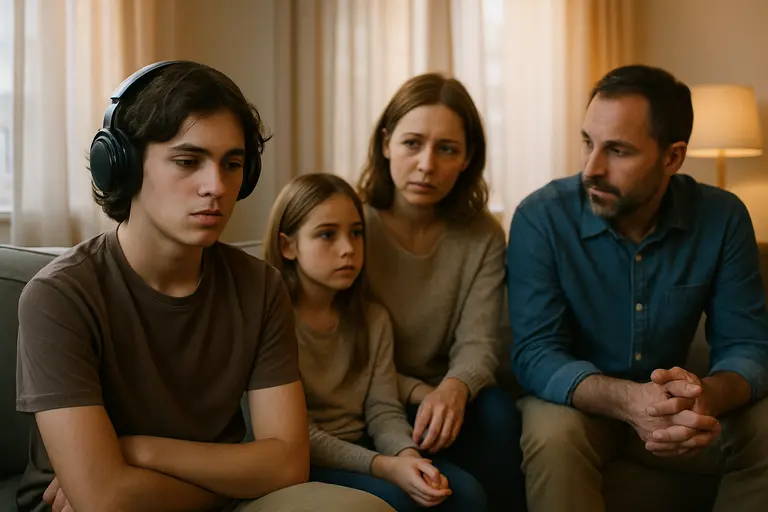
A parent can spend almost the entire day around other people and still have very little time that actually feels restorative.
There may be children asking questions before breakfast, a school drop-off, work messages, appointments, groceries, dinner, homework, sibling conflict, household tasks, bedtime, and then another round of preparation for tomorrow.
Even moments that look like downtime may contain responsibility.
A parent sits on the couch, but remains alert for the child who might wake up. They watch television while folding laundry. They go to a birthday party but supervise children the entire time. They exercise while calculating whether they can finish before pickup. They answer a friend’s message while preparing dinner.
They are rarely alone.
That does not necessarily mean they are recovering.
New research from Florida International University (FIU) offers a timely illustration of why caregiver capacity matters. On August 6, 2026, FIU reported findings from researchers at its Center for Children and Families who surveyed 822 U.S. caregivers of children ages 4 to 8. Parents experiencing greater emotional distress were less consistent in enforcing screen-time limits, while those who felt overwhelmed by their child’s behavior were more likely to use screens to manage difficult moments.
Lead author Enid Moreira, an FIU psychology doctoral student, emphasized that caregivers’ own stress was important to understanding how families used media. Senior author Shayl Griffith, an assistant professor in FIU’s Department of Counseling, Recreation and School Psychology, similarly emphasized supporting caregivers rather than simply demanding stricter rules.
That does not mean stressed parents are destined to have difficulty with boundaries, nor does the study establish that parental stress causes a particular pattern of screen use. The research examined associations based on caregiver reports.
But it supports a larger idea that deserves more attention:
Sometimes the family problem everyone can see is connected to a parent who has very little capacity left.
Being With Your Family Is Not Automatically Recovery
Family connection can be deeply meaningful.
It can provide affection, belonging, humor, purpose, and emotional support.
But family time and recovery are not interchangeable.
Consider a parent spending Saturday at a child’s soccer tournament.
They may enjoy being there.
They may love watching their child play.
They may talk with other parents and feel socially connected.
They may also spend six hours packing food, driving, locating equipment, monitoring siblings, managing schedules, helping a disappointed child after a loss, and thinking about everything that still needs to happen when they get home.
That can be a good day.
It can also be tiring.
Both can be true.
The same applies at home. Playing with children may be enjoyable without being psychologically restorative. Dinner together may provide connection while still requiring planning and supervision. A family vacation can create wonderful memories while producing enormous logistical demands for the person organizing it.
Parents do not have to characterize family life negatively to acknowledge this distinction.
Recovery is not a measure of how much you love the people around you.
U.S. Parents Already Report High Levels Of Stress
The new FIU findings exist within a much broader pattern.
The U.S. Surgeon General’s Parents Under Pressure advisory identified parental mental health and well-being as a public-health priority.
According to data highlighted in the advisory, 33% of parents reported high levels of stress during the previous month in 2023, compared with 20% of other adults. Even more strikingly, 48% of parents said that on most days their stress was completely overwhelming, compared with 26% of other adults.
The advisory identifies numerous sources of parental stress, including financial strain, time demands, children’s health and safety, parental isolation and loneliness, technology and social media, and concerns about children’s futures. The Surgeon General’s parental mental-health guidance also emphasizes that supporting parents requires action from families, communities, employers, healthcare systems, and policymakers—not simply greater individual coping ability.
Those statistics should not be interpreted as meaning that ordinary parenting is inherently damaging to mental health.
Parenting can bring substantial meaning, connection, joy, and purpose.
The point is that meaningful work can still be demanding.
Recovery Is More Than Doing Nothing
When people hear the word recovery, they may imagine lying on a beach, taking a vacation, spending a day at a spa, or somehow finding several uninterrupted hours that do not exist.
That makes recovery feel unrealistic for many parents.
A more useful definition is simpler:
Recovery is time when demands decrease enough for some of your physical or psychological resources to replenish.
That can happen in different ways.
Sometimes it means rest.
Sometimes it means movement.
Sometimes it means being alone.
Sometimes it means spending time with another adult who does not need anything from you.
Sometimes it means doing something absorbing enough that your attention stops cycling through responsibilities.
Sometimes it is simply having 20 minutes when nobody is asking you to make a decision.
There is no universal recovery activity.
A quiet room may feel restorative to one parent and isolating to another.
Running may help one person decompress while feeling like another obligation to someone else.
Socializing can replenish an extroverted parent and exhaust someone who has spent the entire day interacting with people.
The useful question is not:
What counts as self-care?
It is:
What actually leaves me with more capacity afterward?
Why Screen Time Can Become A Stress Story
This is what makes the August FIU study particularly useful.
It would be easy to turn the findings into another article telling parents to reduce children’s screen time.
That would miss much of the researchers’ point.
The study, published in Family Relations, examined how different types of parenting stress were associated with media-management strategies among caregivers of young children.
Greater parental emotional distress was associated with less consistent enforcement of screen limits. Feeling overwhelmed by children’s behavior was associated with greater use of screens to manage difficult moments.
Importantly, the researchers did not conclude that using a screen during a difficult moment is inherently harmful. They encouraged families to consider the quality and context of media use and how it fits within the child’s broader routine.
That changes the practical question.
Instead of immediately asking:
Why can’t this parent enforce the rule?
we might sometimes ask:
What resources does this parent have available at 6:30 p.m. after an exhausting day?
The answer might reveal more about the situation.
Capacity Changes How Easy Good Intentions Are To Follow
Most parents already know many of the things they are “supposed” to do.
Be patient.
Be consistent.
Prepare healthy food.
Limit screens.
Encourage physical activity.
Maintain bedtime routines.
Help with homework.
Listen attentively.
Spend quality time together.
Keep the house functioning.
Manage work.
Take care of yourself.
The difficulty is rarely that no one has told parents these things.
The problem is that every desirable behavior requires some combination of time, attention, money, energy, planning, emotional regulation, or support.
Those resources fluctuate.
Imagine a parent trying to handle a child’s bedtime resistance after a reasonably manageable day.
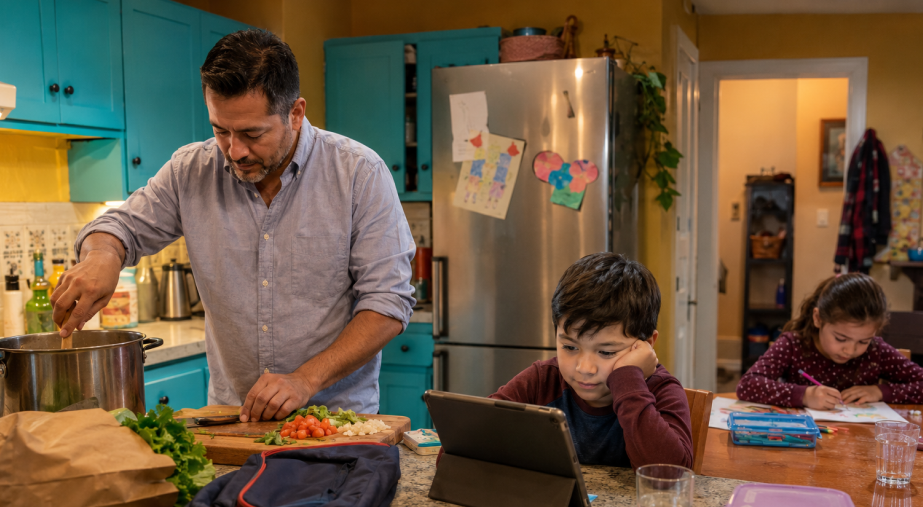
Now imagine the same situation after the parent slept badly, worked nine hours, sat in traffic, discovered an unexpected bill, skipped dinner, and spent the evening managing conflict between siblings.
The parenting principle has not changed.
The parent’s available capacity has.
That does not remove responsibility for how adults behave toward children.
It does help explain why support and recovery matter.
Self-Regulation Has A Cost
Parents often perform emotional regulation that children never see.
A child spills something.
The parent is irritated but responds calmly.
A teenager says something hurtful.
The parent delays the argument until everyone is less activated.
A toddler has a public meltdown.
The parent manages embarrassment, frustration, logistics, and the child’s emotions simultaneously.
A child is anxious.
The parent tries to appear steady even while worried themselves.
These moments can be ordinary parts of parenting.
They also require effort.
That is one reason someone can spend an evening “just being with the kids” and finish it exhausted.
Physical activity is not the only thing that consumes energy.
Attention, restraint, decision-making, vigilance, and emotional responsiveness can be demanding too.
Recovery Does Not Have To Be Earned
Another obstacle appears when rest becomes a reward.
I’ll relax when the kitchen is clean.
I’ll exercise after everything else is finished.
I’ll read when everyone stops needing me.
I’ll take time for myself when I’m caught up.
Parenting makes “caught up” a dangerous standard because family life continuously produces new tasks.
There is another meal tomorrow.
Another load of laundry.
Another message from school.
Another appointment.
Another form.
Another mess.
If recovery can happen only when all responsibilities are complete, it may rarely happen.
This does not mean ignoring necessary tasks.
It means treating some recovery as part of maintaining capacity rather than as a prize for achieving perfect household completion.
Tiny Breaks Can Help Without Pretending They Solve Everything
Short breaks deserve careful framing.
Five quiet minutes can be useful.
They cannot fix financial insecurity.
A walk can help someone decompress.
It cannot create affordable childcare.
Breathing slowly can reduce immediate activation for some people.
It cannot make an unreasonable work schedule reasonable.
A relaxing shower does not solve an unequal distribution of household labor.
Individual coping tools are most useful when we are clear about their limits.
For a parent with very little discretionary time, however, small recovery opportunities can still be worth protecting.
That might mean sitting in the parked car for five minutes before going inside.
Walking around the block without turning it into a fitness goal.
Listening to music after children are asleep instead of immediately beginning another task.
Taking lunch away from a work screen when possible.
Letting another capable adult handle bedtime occasionally.
Having a conversation that is not about children, work, schedules, or problems.
The purpose is not to build a perfect wellness routine.
It is to create moments when demands decrease.
Sharing Responsibility Is A Recovery Strategy Too
Discussions of parental wellness often focus on what the individual parent should do differently.
Sometimes the most effective intervention is not another coping technique.
It is another person doing part of the work.
In households with multiple capable adults, that can mean examining invisible responsibilities as well as obvious chores.
Who remembers appointments?
Who tracks school deadlines?
Who notices that groceries are running out?
Who organizes childcare?
Who handles communication with teachers?
Who plans birthdays?
Who anticipates what children will need next week?
Who becomes the default parent when something goes wrong?
Two people can divide visible chores while one person still carries most of the planning and monitoring.
Reducing that cognitive load can create recovery capacity without adding a new “self-care” activity.
The Surgeon General’s advisory explicitly argues that parental well-being cannot be treated solely as an individual responsibility. It calls for stronger social infrastructure, supportive workplaces, accessible healthcare, economic support, and community-level changes. Parents Under Pressure provides the broader evidence and recommendations behind that approach.
Being Surrounded By People Can Still Feel Lonely
There is another apparent contradiction in parenting.
Someone can almost never be alone and still feel lonely.
That is because company and connection are different experiences.
A parent may spend all day communicating while having few conversations in which they are not managing someone else’s needs.
They may interact with teachers, coworkers, children, coaches, other parents, medical offices, and family members without ever talking about themselves.
The Surgeon General’s advisory identifies parental isolation and loneliness among the stressors affecting caregivers.
This does not mean every parent needs a large social network.
Some may benefit from one dependable friendship.
Others value a parent group, recreational activity, faith community, neighborhood relationship, extended family connection, or online community that genuinely supports them.
The important feature is having somewhere the parent can exist as a whole person rather than only as the person responsible for everyone else.

Parents Still Need Identities That Are Not Entirely About Parenting
Becoming a parent changes identity.
It does not necessarily need to erase everything that came before it.
Someone can be a mother and still be a runner.
A father and a musician.
A caregiver and a friend.
A parent and someone who loves books, gardening, basketball, woodworking, gaming, hiking, cooking, art, or quiet Saturday mornings.
Those identities do not compete automatically with loving children.
In some cases, reconnecting with them can provide recovery precisely because they engage a part of the person that is not organized around responsibility.
This does not need to become another pressure:
Maintain hobbies or you’re doing wellness wrong.
Life stages differ.
A parent caring for a newborn has different options from someone whose children are teenagers.
A single parent has different constraints from a household with several available caregivers.
Someone working two jobs has different flexibility from someone with paid leave and reliable childcare.
Useful advice has to respect those differences.
Recovery Is Not Equally Available To Everyone
It is easy to recommend rest from a position of resources.
“Take a break” means something very different to a parent with paid childcare than to a single parent working an unpredictable hourly schedule.
Financial strain, housing instability, caregiving for disabled or medically complex children, unsafe neighborhoods, discrimination, limited healthcare access, inflexible employment, and lack of family support can all change what recovery is realistically available.
The Surgeon General’s advisory specifically recognizes that parental mental health is shaped by broader social and economic conditions, not merely personal habits.
That is an important safety boundary for resilience content.
We should not turn limited recovery into another reason for parents to blame themselves.
Sometimes a person does not need better time management.
They need more time.
Sometimes they do not need stronger boundaries.
They need an employer who respects them.
Sometimes they do not need a mindfulness practice.
They need childcare.
Sometimes they do not need to become more resilient.
They need help.

Ask What Is Actually Draining You
When exhaustion becomes persistent, generic self-care advice may be too broad.
It can be more useful to identify the demand.
Is the biggest drain sleep interruption?
Financial worry?
Work?
Conflict with a partner?
A child’s health needs?
Constant transportation?
Household management?
Social isolation?
Caregiving without backup?
Trying to meet unrealistic expectations?
The answer matters because different problems require different responses.
If sleep is being disrupted by an infant, a motivational podcast is unlikely to solve the problem.
If one parent is carrying almost all household planning, a bubble bath does not redistribute responsibility.
If work is the primary source of overload, the most meaningful change may involve schedules, workload, leave, boundaries, or workplace support where those options exist.
Resilience becomes more useful when it increases the number of responses available rather than telling someone to tolerate the same conditions more efficiently.
Children Do Not Need A Parent Who Never Gets Tired
Parents can absorb unrealistic ideas about emotional steadiness.
Never lose patience.
Always be present.
Always enjoy the moment.
Remain calm.
Make childhood magical.
Maintain boundaries perfectly.
These standards leave very little room for being human.
Parents will become frustrated.
They will make mistakes.
They will sometimes use the easy dinner.
Sometimes children will watch television because an adult needs 30 quiet minutes.
A routine will occasionally fall apart.
None of those moments alone defines a family’s well-being.
What matters more is the broader pattern, the safety of the environment, the capacity for repair, and whether parents and children can get appropriate support when problems persist.
The FIU researchers’ emphasis on realistic media habits is useful here. They recommended considering whether media displaces important activities such as sleep, physical activity, or family interaction rather than treating every minute of screen use as equivalent.
That is a much more workable approach than perfection.
Recovery Can Be Planned Before Exhaustion Peaks
Parents frequently wait until they are depleted before taking recovery seriously.
A better question may be:
Where does recovery normally happen in this week?
If the answer is nowhere, that is useful information.
It does not mean someone must immediately redesign family life.
Start smaller.
Is there one recurring responsibility someone else can own?
Can one evening contain fewer decisions?
Is there a 20-minute transition between work and caregiving?
Can a friend or relative help regularly rather than only when things become desperate?
Can one optional commitment disappear?
Can partners protect equivalent off-duty periods where circumstances permit?
Can the family lower a standard that consumes energy without adding much value?
The aim is not equal leisure every day.
It is preventing recovery from becoming something that exists only after a person reaches the edge of their capacity.
When Exhaustion Needs More Than Rest
Parental stress is common.
That does not mean every persistent psychological difficulty should be attributed to parenting.
Ongoing low mood, severe anxiety, major sleep disruption beyond what circumstances explain, increasing substance use, intense irritability, persistent hopelessness, inability to manage everyday responsibilities, or other concerning changes may warrant discussion with a qualified healthcare or mental-health professional.
Parents do not need to determine for themselves whether what they are experiencing is “normal stress” or a diagnosable condition before asking for help.
Professional assessment can help make that distinction.
Immediate safety concerns require more urgent support. In the United States, people experiencing a mental-health or suicide crisis can call or text 988 for the Suicide & Crisis Lifeline. For an immediate life-threatening emergency, use 911 or appropriate local emergency services.
Seeking professional support does not mean someone has failed to cope with parenting.
It means individual coping has limits.
A Family Can Be Loving And A Parent Can Still Need A Break
Perhaps the most useful distinction is the simplest one.
Needing recovery does not mean wanting less family.
A parent can love bedtime stories and sometimes wish someone else would handle bedtime.
They can enjoy children’s sports and still want a weekend without logistics.
They can feel grateful for family life and exhausted by it.
They can want connection and solitude.
They can be competent and need help.
They can be resilient and need rest.
The 822-caregiver FIU study gives us a concrete example of why caregiver stress belongs inside conversations about children’s routines. When parents were more distressed or overwhelmed, their approaches to screen media differed. The researchers’ response was not simply to demand better discipline; it was to emphasize supporting caregivers and creating realistic family media habits. FIU’s parenting stress research provides the August 2026 findings and practical context.
That principle travels well beyond screens.
When family routines start becoming harder, we can examine the behavior.
But we can also examine the capacity behind it.
Sometimes the parent does not need another instruction.
They need somewhere in their life where they are allowed to recover, too.